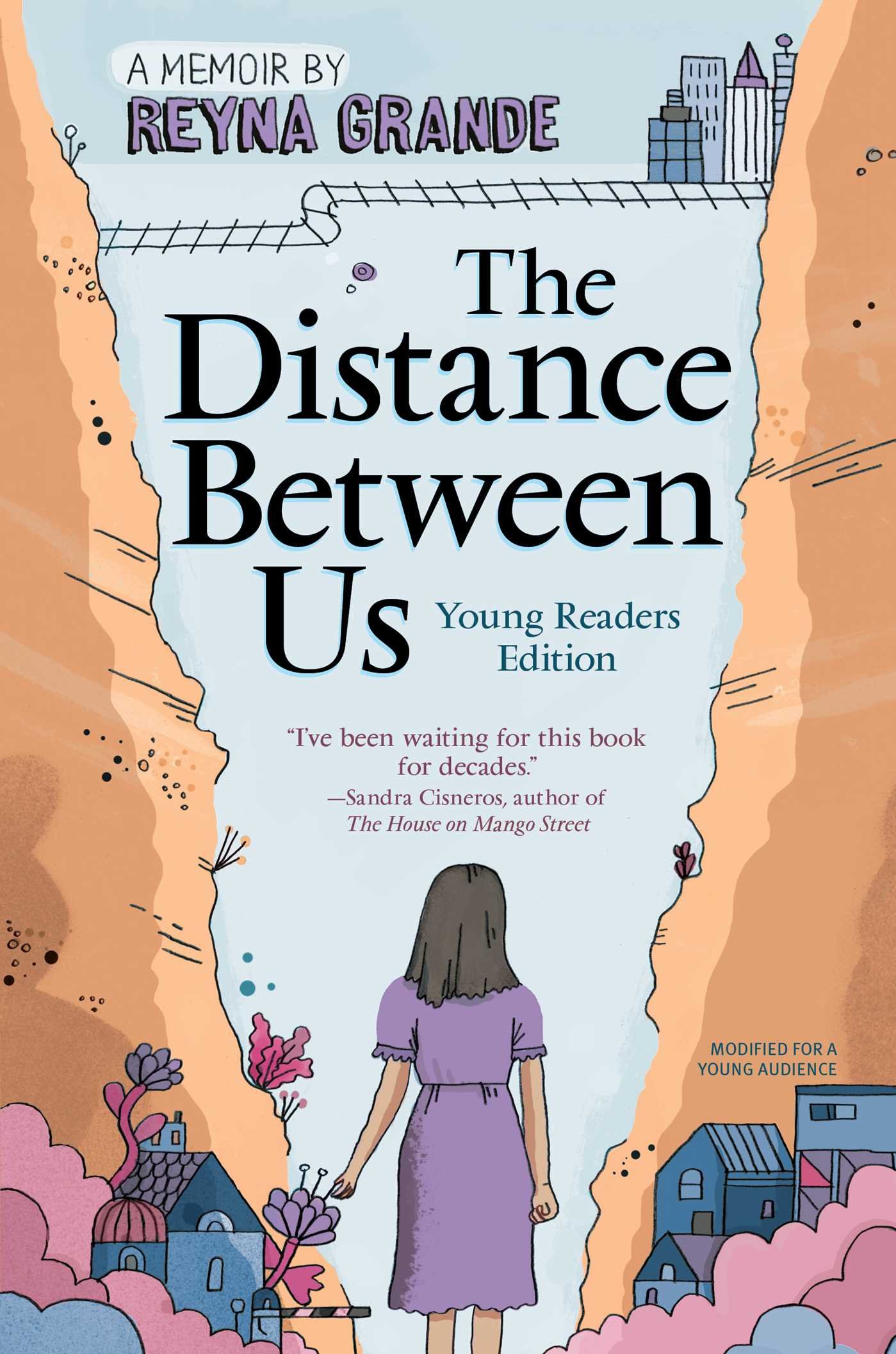
The Distance Between Us

Image result for the distance between us

The Distance Between Us (Young Readers Edition) by Reyna Grande

Literary Awards: 2017 Honor Book Award for the Américas Award for Children’s and Young Adult Literature, 2016 Eureka! Honor Awards from the California Reading Association,  International Literacy Association Children’s Book Award 2017

Focus: Memoir

About the Author

Image result for reyna grande

Reyna Grande was born and raised in Iguala, Mexico. When she was only two her father moved to the U.S. to find work. Her mother followed two years later, leaving Reyna and her siblings to live with their grandmother in Mexcio. When she was ten she made her own journey across the border into the U.S. as an undocumented immigrant. She went on to obtain her B.A. in creative writing and film & video from the University of California, Santa Cruz. She later received her M.F.A. in creative writing from Antioch University. She is now an award-winning novelist and memoirist. Reyna says that one of the reasons she writes is she can revisit Mexico and claim it as her own in a way she can’t in real life. Her works have been published internationally in Norway, South Korea, and Mexico. Currently, she teaches creative writing and is a prevailing motivational speaker.

Summary

Reyna Grande was born in Iguala, Mexico. When she was only two, her father went to El Otro Lado “The Other Side,” which is what people in her village called the United States. All she had to remember him by was a framed picture, which she nicknamed “The Man Behind the Glass.” Her father went to fulfill his dream of building a strong, safe house for his family. When Reyna was four, her mother left to join her father in the U.S. Reyna, her older sister Mago and brother Carlos had to go live with their Abuela Evila, a woman who was “born angry.” Their cousin, Elida, also lived with Abuela as her mother left to live in El Otro Lado as well. Mami promises her children she will only be gone one year and every dollar earned will go towards building their house.

Living with Abuela Evila is hell for the Grande children. Abuela Evila treats them with disdain, doing only the bare minimum to meet their needs. Often Reyna and her siblings are starved with heads full of lice and bellies full of tapeworm. Abuela Evila only gives them two minutes to talk with their parents and takes most of the money Papi and Mami send for the children to spend on Evila. Evila is treated like a princess; she is doted on and gets anything she wants. She is cruel to the Grande children while they are forced to do chores and follow Abuela’s strict rules. Reyna describes living there like “living in a prison.” Mago takes on the role of “little mother” and does what she can to be the kind caregiver their Abuela was not and remind Reyna and Carlos that they are not orphans.  She takes Reyna to the small house they grew up in and reminds her that her umbilical cord is buried in the dirt of the floor and this “was like a ribbon that connected her to Mami.” She tells her, “It doesn’t matter that there is distance between us now. That cord is there forever.” This is a hard and confusing time for Reyna as she constantly wonders when her parents will return and if they really love her. Then, they find out Mami has had a baby. Mago reacts to this news the strongest and becomes a meaner version of herself after hearing the news. When Mami and Papi send the children Christmas presents of clothes that are way too small, the three of them realize that “the distance between us and our parents was tearing us apart.”

One day without warning, Mami returns. Reyna finds out that she left Papi because he was having an affair with another woman. Reyna concludes that  “the woman standing there wasn’t the woman who left.” Mami is no longer the loving, nurturing mother the kids remembered. She was angry and indifferent to her children’s needs. She meets a new boyfriend and leaves the children again. She returns after he is killed in a car accident only to leave soon again to live with her sister. Reyna and her siblings live with their Abuela Chinta during this time. She is a wise, kind woman but struggles to care for the three children.

After eight years, Papi returns with Mila, the woman he left Mami for. He asks Mami permission to take the children with him to the U.S. Mami agrees, but on one condition; Betty, the youngest must stay. Though this breaks Reyna’s heart, she wants to go with Papi and so they make the treacherous journey across the border. Two  times they attempt to cross only to be caught and sent back to Mexico. On their third and final try they are successful and Mago, Reyna and Carlos begin their new life in America.

Reyna’s life in America was tumultuous and complicated. Papi’s “dark side” came out more and more frequently as he tried to instill in his children the value of getting a good education and creating a stable adult life the only way he knew; with threats and violence.  Abusive and controlling, Papi created an unstable home for his children causing them to constantly wonder if he is going to send them back to Mexico and leave them again. Reyna’s life is complicated as she seeks to find a sense of belonging and family who loves her. Through it all is Mago; the only constant in her life. Their bond is deep and formative. As Reyna struggles with learning English, trying to make her father proud, navigating her intricate relationship with her mother and Mila and the angst of being a teenager, Mago is always there to love and support her. Eventually, Reyna finds the inner strength to step out of the shadows and fight for the life she wants. Her hero, Diana, opens her eyes to an entire world of literature that speaks to her soul. After reading The House on Mango Street by Sandra Cisneros, Reyna wanted to ask her “How did you know? How did you know this is how I felt? For the first time in her life she found herself reading about characters who lived in her world, shared her dreams. Some day, she would do the same for other children and inspire them with her story of bravery.

Author’s Use of Language

Reyna flawlessly combines all the elements of a well-written book to tell her story in a clear, interesting way. In truth, I got so lost in her story, I had a hard time zeroing in on what exactly made her writing so compelling. But, as Tunnell states, “The elements of writing are integrated, worked into a well-orchestrated whole, by a talented writer” (pg 25). Here are some examples of where Reyna does this:

  • “That was how I found Papi in the voice of Vicente Fernandez. I learned to find him in a bottle of Old Spice we found in a trash heap.” (pg 27) Reyna is desperate to maintain her “relationship” with her father even though all she has is a framed picture of him. The simple wording of “I found him by…” shows how Reyna was able to activate her senses as a way to connect and remember her father and remind herself he was her father and he would come back for her someday.


  • In the paragraph below (page 59), Reyna uses strong descriptive language to create imagery. Through that imagery she is able to show the conflict she feels about her country and the divide it has caused in her family.

Screen Shot 2018-06-28 at 2.54.24 PM

  • On page 241, Reyna uses figurative language to describe her first kiss with a boy named Luis. Her words are able to transport the reader into the moment so we can feel joy alongside her.

Screen Shot 2018-06-28 at 3.00.58 PM

  • On page 275, Reyna says, “I’d follow Mago to the end of the Earth if I had to.” That one line conveys her entire past, present and future with Mago. One beautifully constructed sentence is able to summarize the bond between the two of them.

Mentor Text

The Distance Between Us is a wonderful book to use as a mentor text for a genre study on memoirs. With this specific genre, I think it is great to expose students to short memoirs in both written, audio and video format. Using the graphic organizer below (in lesson ideas), students can analyze different people’s memoirs to get a sense of the genre. Then, students can work together to create an anchor chart that lists the characteristics of a memoir. After clarifying and creating a class anchor chart, I love to challenge students to describe the difference between a memoir and biography or memoir and autobiography. This is also a great “hook” into the unit of study and allows students to construct their own understanding of what a memoir is. After this, I would use The Distance Between Us as a mentor text to analyze and discuss in order to prepare students to write their own memoirs.

Lesson Ideas

I would use some sort of graphic organizer to help students analyze The Distance Between Us. There are many things in this book for students to critically examine and discuss. Using some sort of graphic organizer (an example is below) can help students structure their thinking. This also allows students to work with “chunks” of text as opposed to trying to analyze the whole book at once.

AnalyzingMemoirsGraphicOrganizer

Once students had the opportunity to read, analyze and discuss The Distance Between Us, I would have them write their own memoirs. This is where I think it is important they have different examples of memoirs to consider as they plan their own. Reyna’s memoir encompasses almost her entire life. Some memoirs only focus on small moments in a person’s life. I would leave it up to the students to decide which type of memoir they would want to write to share with the class.

Thinking Beyond the Text

In talking about her book, Reyna states that she noticed voices of immigrant children were not reflected in the books she was reading. Right now, hundreds of thousands of children are attempting to enter into the United States. Forced to leave behind their countries because of extreme poverty and limited opportunities, these families are seeking a safe and better life. In thinking about our current political climate and current state of affairs concerning immigration into the United States, no topic could be more relevant for students to consider. Reyna’s memoir is brave; she shares the hardship of her life and narrates what it was like to illegally enter the United States and live undocumented for many years. Many students will be able to connect with her experience as it may be similar to their own. For students who have not had this experience, nothing could be more eye-opening and profound than to read about what it is really like for so many immigrants. Today’s media is full of misinformation. Students need to be educated about this issue and seek to build their empathy in order to act as agents of change and be the ones on the front lines of fighting for social justice. Authors like Reyna open up a whole new world for students as they share firsthand experiences and inspire students to do the same. The message that resounds is “you are not alone.”

Q & A

1. Who has the power? How is this power shown?

Papi has incredible power over his family. After leaving his children in Mexico for eight years, he is still able to return as a hero. Beloved by his children, they are so happy to be “saved” by him and forgive him for years of being absent. Papi decides what his children’s life should be and the minute they do something that doesn’t align with his expectations, he beats them into submission or cuts them out altogether. When Reyna is begging to see Mago, which Papi has forbidden, she cries in anguish, recognizing his power over her. She says, “He always knew how to say things that would hurt me to the core. I hated crying. I hated letting him see how much power he had over me, to make me cry just like that, not even having laid a finger on me.” Papi almost took away Reyna’s entire future when he wouldn’t allow her to go to college, he beat her senseless time and time again and tried to take away her sister. Yet, when Mila left him, Reyna returned to his side because she felt obligated to do so. Only when Papi died was Reyna able to break his hold on her once and for all and let it all go.

2. How are family relationships depicted?

It was really eye-opening to read Reyna’s story and consider how complicated family relationships become in immigrant families where there is a cycle of leaving children. Reyna had to negotiate her relationship with her Papi, a man who taught her to dream but used violence to keep her close. Then, Mami, who constantly left her and clearly wanted a life free from her responsibilities as a mother. Her deep bond with her sister was unique as Mago assumed the roles of her mother, sister and best friend. And then, there was her relationship with Mila; a woman who broke up her family and yet Reyna wanted to play the role of her mother. This made her jealous of Mila’s biological children. As Reyna returns back to Mexico to re-connect with relationships and family there; she finds she is now an outsider. She was no longer one of them because she was not “Mexican” enough. She would never have the same relationship with her native home or its people again. It is no wonder Reyna said she was constantly trying to figure out where her home was and where she truly belonged.

3. What attitudes are shown toward emerging bilingual students in schools as portrayed in The Distance Between Us?

I feel that Reyna’s experience in schools is similar to what many non-native students experience. They are made to feel like outsiders who are not assimilated into general education classes with their peers. They are separated in small groups, different classes and are taught content below their cognitive level. Like Reyna, I feel like many students feel that it is just easier to try to be invisible. How saddening; how much a school community suffers when voices of all students are not heard and celebrated. When Reyna’s teacher wouldn’t even consider her story because it was written in Spanish I was heartbroken and angry all at the same time. So many students across the U.S. are not being given the opportunities they deserve simply because they are still working to acquire English. The attitudes toward these students as shown in the book reflect the desperate need multicultural literature can fill in educating both students AND teachers to create a more tolerant, supportive classroom environment that welcomes and supports all students.
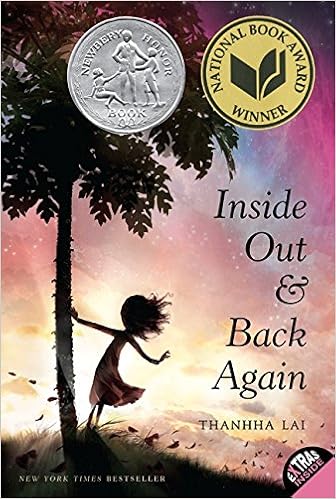
 

Inside Out and Back Again

Image result for inside out and back again

June 27, 2018

Inside Out and Back Again by Thanhha Lai

Literary Awards: Newberry Honor (2012), National Book Award (2011)

Focus: Poetry, Historical Fiction

About the Author

Image result for thanhha lai


Thanhha Lai was born in Saigon, Vietnam. She immigrated to Montgomery, Alabama after the war in 1975. It took Lai 15 years to write Inside Out and Back Again, her semi-autobiographical novel. This was also her first novel. Many details in the story were inspired by her own memories. Lai currently lives in New York. She has a  journalism degree from the University of Texas at Austin and an MFA in writing from New York University. She also teaches writing at Parsons School of Design. She started a non-profit organization called Viet for Kids Inc. with the goal of buying bicycles for students who are unable to afford them and have to walk two hours to and from school. A bike allows them to spend their energy in the classroom. Each year, Viet Kids has been able to give away 30 to 50 bikes, plus funding for tuition, uniforms, and rice—basics that every student needs.

Viet for Kids, Inc. Lai’s non-profit organization which raises money for kids in Vietnam. 

Summary

The story begins in 1975 in Saigon, Vietnam. Ha is a ten year old spitfire who shows defiance in the face of cultural traditions that don’t allow her to be her true self. On the eve of Tet, the Vietnamese New Year, Ha’s mother insists that one of Ha’s brothers must rise first to bless the house because only male’s feet bring good luck. Ha decides to get up earlier than her brothers and “tap her big toe on the tile of the floor first.” But, everything in her life changes as the Vietnam War reaches her home. Nine years ago, her father disappeared during a Navy mission. Ha’s mother has to work hard to provide for the family. As the war moves ever closer, Ha’s mother has to decide what the family should do; stay or flee Vietnam. In a family meeting, Ha’s Brother Quang says it is shameful to leave the country when there is so much work to be done; Brother Khoi wants to stay in case father returns and Brother Vu wants to go. Mother’s eyes,  which always reflect her true feelings, conveys to Ha “You deserve to grow up where you don’t have to worry about saving half a bite of sweet potato” (pg 47). Mother decides to go; Uncle Son, father’s friend from the navy says he has a way for them to get passage on ship bound for Thailand.  Mother shows the boys a portrait of father saying, “Come with us, or we’ll all stay. Think, my son; your action will determine our future” (pg 53). For their mother, the boys decide to go.

The families’ journey across the sea is a harrowing one. Because of the overcrowding on the boat, food and water are in short supply. But, Ha surmises,

“But no one

is heartless enough

to say

stop

because what if they had been

stopped 

before their turn?”

                                                                         April 29, Sunset 

And so, they endure. They endure thirst, seasickness and hunger. They endure the stench of bodies and too many people crowded into one place. About a month later, they  are rescued by an American ship and sent to a refugee camp in Guam. After two months, Mother must decide where they are to go next. With the promise of a better opportunities for her sons, she chooses America. The family is sent to another refugee camp in Florida.

For families to leave this camp, they must be sponsored by an American family. This is hard for Ha’s family since there are so many of them. They wait and wait and finally Mother convinces a man from Alabama to take them all. In Alabama, Ha and her family are forced to learn a new way of living that is foreign to their own. In this new world Ha and her brothers are tormented at school and neighbors greet them with hostility and refusal to accept them. It is not easy, but the family bands together in love and support. Mother continues to encourage her children and reinforce this was the best choice for them, even though she too feels the emotional turmoil of leaving their old life behind. One of the neighbors, Mrs. Washington, is different from the rest. With acceptance and understanding, she becomes Ha’s confidant and advocate. With her love and support, Ha is able to learn better English and come to terms with her new life in America. As the family finally lets go of the hope that father will return, they embrace a new existence where traditions from home can combine with American life to make something new and full of hope.

Author’s Use of Language

Inside Out and Back Again is written as a verse novel. The author combines narrative poems, lyric poems and free verse poems to capture the honesty of Ha’s experience as a refugee.

  • Use of first person point of view in form of journal: By writing the story in the form of a journal, we see Ha in all her complexity and embrace her as a kindred spirit.  Through her point of view, we are able to live the life of a Vietnamese refugee because the author captures Ha’s emotional life. The titles of each “entry” summarize Ha’s life in that moment and helps the reader understand what she is going through. This is especially true in Part III of the book where Ha and her family move to Alabama. Here, we experience firsthand the cruelty of the children towards outsiders, the harm of an unaware teacher and the prejudices of adults. Here is an example of where Ha’s raw emotion explodes off the page: Screen Shot 2018-06-27 at 3.17.46 PM
  • Use of humor:  Throughout the story, the author is able to show us the humorous side of Ha’s personality. We also see her resilience as she is able to keep her sense of humor even in the darkest of times.

The author cleverly inserts English grammar rules to show Ha’s frustration with learning the language. Embedded in these rules we see Ha’s sense of humor which also reflects her cleverness and poignant understanding of life.  

  • Figurative language: Through the use of figurative language, the author  creates strong imagery in the reader’s mind. We see the depth of characters through beautifully worded sentences and phrases.

Screen Shot 2018-06-27 at 3.34.00 PM

This was one of my favorite poems that illustrated the power of Lai’s use of figurative language. I can literally walk in Ha’s shoes and feel her anxiety as she anticipates her first day of school. 

  • Understatement: Oftentimes, Lai allows the reader to draw their own conclusion without telling them exactly what to think. A great example of this is in the poem “Left Behind” on pages 57-59. Ha’s mother is getting together the family’s memorabilia; their sentimental treasures. Lai writes, “Mother chooses ten and burns the rest. We cannot leave evidence of Father’s life that might hurt him.” There is much to consider; is father coming back? Does this imply he is dead? What consequences could there be to leaving personal artifacts behind? The reader must draw these conclusions to understand the depth of meaning portrayed here.


  • Use of precise vocabulary to create rhythm and melody: In writing Inside Out and Back Again, Lai wanted to emulate the work of  Nguyên Du, Vietnam’s most famous poet who could ” convey the world inside two lines of six or eight syllables.” States Lai,  “In writing Inside Out, I did delete every unneeded word. I did read the lines out loud once they were set. In creating them, I thought in Vietnamese in terms of images, then translated those images into English in a way that left the rhythm of the original language intact. The Vietnamese I know, influenced by my mother, is naturally poetic, rhythmic, melodic. Because Vietnamese is based on Chinese, which of course is a language built from images, I was able to express emotions through pictures, not words. Thus I was able to cut many unneeded words, leaving just the core, like boiling down sap to make syrup” (Wolff, 2012). This is precisely the effect she attained.

Screen Shot 2018-06-27 at 3.48.38 PM

Read this poem out loud and you will be able to feel how the preciseness of the vocabulary creates a melodic rhythm that creates strong images that evoke an emotional response. 

Lesson Ideas

I would use Inside Out and Back Again with adolescent students to analyze character. Ha is a complex character; one who has endured a remarkable journey. Through her journal writing, she shares every bit of herself with the reader in an effort to share her story with the world. I have shared the graphic organizer below previously, but I think it is incredibly effective in having students analyze a character from different perspectives to really capture the essence of who they are. Again, it also pulls students back to the text to re-read as they search for text evidence to validate their thinking.

Analyzing Characters Graphic Organizer

As a way for students to demonstrate their understanding of the character, I would have them write an “I Am” poem from the perspective of Ha. In the past, students have enjoyed this activity. I encourage them to use figurative language in their poem to create effect for the reader. As an extension, students could also choose to write an “I Am” poem from the perspective of another character in the book, such as mother, one of the brothers, or Mrs. Washington to further their critical analysis of the text.

I Am Poem Template

Mentor Text

I think this text would serve as a wonderful mentor text for students to analyze the interactions between individuals, events and ideas in a text. This is a challenging standard for middle school students because it is abstract and hard to conceptualize. There are many, many interactions for students to examine and discuss within Inside Out and Back Again that are familiar to students and have meaning for them in their everyday lives. This helps them make the abstract more concrete. For example, students could analyze how ideas influence individuals and events by thinking about how the idea of freedom and opportunity influenced mother to take the family to America.

Looking Beyond the Text

Ha is a strong example of someone who shows grit in the face of difficulty. Giving up was never an option for her. She persevered with the help of friends, family and traditions. I love characters like Ha that have “real” moments students can really connect with. After a terrible day at school, Ha goes to Mrs. Washington’s and has a screaming, crying tantrum to release her anger. Mrs. Washington uses the power of touch to calm Ha and remind her she has support. In another moment of frustration, Ha’s mother encourages her to chant in order to calm her raging emotions. In both instances, she is able to do so, even though the process is messy. This is something I know students can relate to and discuss as it has happened to them or someone in the class.

There is also much to unpack in the hate and ignorance Ha faces when she enters the American school system as well as the way she sees herself as “dumb” because of the language barrier. I would love to challenge students to think about how Ha would be treated if she showed up in our school tomorrow. Furthermore, I would want them to discuss the teacher’s actions; where they right? Wrong? Did her actions create further stereotypes or dispel them? Do teachers at this school support students learning a second language? How or how not? After this conversation, I would want students to reflect on why it is important to know each other’s stories. To me, this is how we build empathic, understanding youth who go on to become empathic, understanding adults.

Before Reading

In the author’s note, Thanhha Lai extends this idea to us all: How much do we know about those around us? Before reading Inside Out and Back Again, I would share Amal Kassir’s Ted Talk called “The Muslim on the Airplane” with students to get them thinking about this question. For middle school students, this is a strong hook into the content of the book and prepares them to think critically in response to the video and as they read Ha’s story. After reading her story, students may be inspired to share their own stories with their peers in an effort to deepen the connection within the community.

Q & A

1. What information does the author assume the reader knows?

Early on in the novel, the author talks about how North and South Vietnam were divided. Communism was a big part of this. The author assumes the reader is familiar with both the country of Vietnam and the concept of Communism. Readers need more background knowledge on the Vietnam war; what caused it, where the fighting occurred, conditions were like. This will help the reader think critically about the perspective presented in the story through the lens of Ha, a Vietnamese girl. With more knowledge of the different religions and traditions of Vietnamese people, students will be able to understand the weight of certain events in the book such as when Ha and her family are baptized into the Christian faith in order to fit in with their new community in Alabama.

2. What do you notice about stereotypes?

When Ha and her family move to Alabama, they encounter many stereotypes Americans have of Vietnamese people. Miss Scott has the entire class clap for Ha when she can recite the ABC’s and count to twenty. She demeans Ha because Ha already knows all these concepts, just not the language. Students ask Ha if she eats dog meat, if she lived in the jungle with tigers and make fun of her name. Her brother gets called “Ching Chong” at school as well. In an attempt to help the class understand Ha, the teacher shows the class graphic images of war torn Vietnam and tells that class that is what Ha’s life was like. By only presenting this one side of the story, she has named Ha “Vietnamese refugee.” This is the name that will stick in the minds of the students. This is a powerful story to share with students in order to analyze and discuss the harmful effects of stereotyping.

3. Why did the author title this book Inside Out and Back Again?

Possibly the author titled the book this way to symbolize Ha’s journey. After leaving her native country, the only home she ever knew, Ha’s life was turned inside out. She had to learn a new language, live in a new culture, adopt a new religion and go to a new school. At moments, Ha’s insides are literally on the outside as we see her raw emotion laid bare. She is not always able to remain composed as she is faced with hate, fear and ignorance. But, at the end of the story, she is able to come “back” in the sense that she starts to figure out her duality. She lets go of some things that will never be the same again- her father will never come home- and seeks to find ways to keep her Vietnamese heritage a part of her.

References:

Wolff, V. (2012). The Inside Story: Thanhha Lai. School Library Journal. 

https://www.slj.com/2012/01/interviews/the-inside-story-thanhha-lai/#_


The Crossover

Image result for the crossover

June 26, 2018

The Crossover by Kwame Alexander

Literary Awards: Newbery Award (2015), Correta Scott King Award (2015)

Focus: Poetry; Contemporary Realistic Fiction

About the Author

Image result for kwame alexander

Kwame Alexander is a poet, educator, and the New York Times bestselling author. He writes for children of all ages. Kwame believes that poetry can change the world and he uses it to inspire and empower young people around the world. He founded a K-12 writing program called “The Write Thing.” This Book-in-a-Day writing and publishing program has created more than 3000 student authors. Kwame regularly speaks at conferences and universities all over the world. Recently, he lead a delegation of twenty writers and activists to Ghana where they delivered books, built a library and provided literacy professional development to teachers. He also co-founded LEAP for Ghana, an International Literacy Program. Kwame was also the 2018 NEA Read Across America ambassador.

Summary

Twelve year old Josh Bell is a basketball phenom just like his identical twin brother JB. Sons of basketball legend Chuck “Da Man” Bell, basketball is in their blood. Josh’s Dad gives him the nickname “Filthy McNasty” after the name of a famous jazz song (and also because he was generally dirty). At first, Josh doesn’t love the nickname, but it takes on a special meaning when it becomes a code between him and his Dad when he is on the court; a signal he is doing well. Josh feels inspired when he is on the court, and this comes out in the rhymes that flow through him when he plays.

Screen Shot 2018-06-26 at 6.38.04 PM

The words and rhythmic flow of these words on the page depict Josh’s inner thoughts; his “flow” on the court.

Josh and JB generally get along; but they have very different personalities. We see this in Josh’s description of their playing style. On page 26, he says, “JB likes to taunt and trash talk during games like Dad used to do when he played. When I walk onto the court I prefer silence so I can watch, react, surprise.” They are teammates in every sense of the word; able to wordlessly communicate on the court to become the stars of the team. The “crossover” is Josh’s signature move, something his Dad taught him. Josh’s mom is the assistant principal at his school, a fact he doesn’t love. His family unit is strong, though it is not always perfect. His parents continue to press upon him the value of working hard and the importance of education. Josh also has a strong relationship with his basketball coach and receives much guidance and support from him as well. With his eyes on a future at Duke, Josh seems to have it all. But then, things start to unravel as JB starts to get more interested in girls.

One day in school, JB passes a note to Josh to give to a girl he really likes, who Josh nicknames “Miss Sweet Tea.” Josh states that “somewhere between camaraderie and imbecile I tap her beige bare shoulder with the note” (pg. 80). Josh chooses to give her the note for his brother and takes the rap for cheating. This is the beginning of a big change in Josh and JB’s relationship. At one point, Josh begs his Dad to intervene and talk to JB, to which he replies, “Filthy, if some girl done locked up JB, he’s going to jail. Now let’s go get some doughnuts” (pg 92). Josh grows resentful of JB’s new relationship with his girlfriend as he feels left out and lonely. He even uses the word “churlish” to describe himself. As his relationship unravels with his brother, he finds himself at odds more and more with his parents.  It doesn’t help that his Dad keeps having health issues, but won’t go to the doctor because he thinks this is a stupid waste of time.

One night while on the way to a game, Josh’s Dad gets pulled over for a broken taillight. Coach doesn’t allow Josh to start the game since he was late, and later, something in Josh snaps. Instead of passing JB the ball when he was wide open, he smashes him in the face with a pass hard enough to draw blood. As a consequence for his actions, his mom suspends him from the team. Josh goes about his routine, trying hard to repair what had been broken between JB and him. Then, everything in his world comes crashing down.

His Dad has a heart attack and slips into a coma. His dad revives and spends nineteen days in the hospital as Josh tries to get used to his new existence alone without JB who used to be his best friend. As Josh plays in the final game of the season, his Dad dies from a massive heart attack. He was only 39 and might have had a chance if he had seen a doctor sooner. After the funeral, Josh makes another attempt to reconcile with JB when JB gives him his father’s championship ring by saying, “We Da Man.” The author leaves us with the sense that the brothers will find their way back to each other.

Author’s Use of Language

Dr. Rudine Sims Bishop makes the point that in multicultural literature, a character’s humanity should come through. Kwame Alexander is able to  to seamlessly bring different poetry elements, forms of poetry and genres of writing together to help the reader experience Josh’s life and his humanity, as opposed to just reading about it. Thus, readers come to know how the power of words and vibrant language evoke deep emotional responses as we read about Josh’s life. 

  • Use of Poetic Elements: The author uses a variety of figurative language, repetition, rhyme, rhythm and free verse throughout the book. Below are some examples:

    In “Dear Jordan,” we see the author’s use of similes and metaphors in the letter Josh writes to JD in order to convey how sorry he is. In “Mom, since you asked…” the author uses repetition to illustrate Josh’s venting of everything that is causing his inner turmoil and anger.

    Screen Shot 2018-06-26 at 7.57.12 PM

    In this poem, the author uses short, choppy lines to convey a sense of urgency; this narrates the story of Josh’s dad’s heart attack. 


  • Forms of Poetry: Josh’s story is told in the format of a basketball game. It starts with the warm-up, transitions to the first quarter and ends in overtime. This signals the reader that the book is a narrative poem, a poem that tells a story. However, some parts of the book are written as a lyric poem, which is melodic and soundlike. Generally, this type of poem “focuses on personal moments or feelings or image laden scenes” (Tunnell et al. 2016, pg 98). We see this form emerge in Josh’s thoughts about his game. These poems are also concrete poems, taking on the shape of the words to further represent how Josh feels when he plays basketball.Screen Shot 2018-06-26 at 7.50.24 PM


  • Different Formats of Writing: The author uses different formats of writing (text messages, phone conversations, dialogue and time sequence) to create authenticity in the story. Here we see dialects and language specific to the culture emerge. For example, in the lines “Jordan insists that everyone call him JB. His favorite player is Michael Jordan, but he doesn’t want people to think he’s sweating him. Even though he is.” The line “he’s sweating him” is a phrase that is maybe not familiar to the reader, but it accurately represents the vernacular of the characters.unnamedIn this conversation between Josh and his father, the font indicates who is speaking. The conversation is natural which is a strong representation of the dynamic between father and son. 


  • Vocabulary: Throughout the story, the author directly introduces the reader to new vocabulary in a very unique way. Josh gives the definition of a word that further expound on his current state of mind. Often, these reveal Josh’s sense of humor in a way that is fun and entertaining. Screen Shot 2018-06-26 at 8.16.08 PM


Mentor Text

The Crossover is a wonderful mentor text for adolescent writers. Exposing students to verse novels such as this allows them to explore the artistic elements that combine to evoke personal and powerful emotions in the reader. Ruth Bishop said that poetry “has a kind of magic and can help the reader see ordinary things in new ways.” In The Crossover, Alexander takes risks with his writing to authentically represent the culture of Josh, his family and friends. By doing so we are pulled into Josh’s life in the most intimate way; allowing us to make connections to our own lives and experiences. This further allows students to “practice at life” as they experience Josh’s reactions to conflict relevant to their own lives in the story. Exploration of this text can be a gateway into  students writing.

Lesson Ideas

I would use this book with adolescent students as a way to inspire them to explore self-expression through writing. By analyzing how Alexander is able to use voice, word choice, sentence fluency and original ideas to write a powerful story, students will be able to create a story that reflects their own original idea. Thus, they will be able to create characters based on what they know or what they want to see reflected in literature.

Looking Beyond the Text

The Crossover has so much meaning for young adults. They will be able to relate to the topic, theme, setting and emotion conveyed in the story. The characters listen to the same music as they do, covet the same shoes, use the same slang. Both Josh’s parents and basketball coach provide non-didactic moral education for students to consider. For example, Josh’s mother tells him, “Boys with no self-control become men behind bars.” This is a reality for African American boys in today’s society. This is a life lesson that many young readers have a strong reaction to and would welcome the opportunity to discuss in a safe environment to voice their anger, fear and outrage. On page 185, Coach shares with Josh that he got into a fight with his brother in high school and now they are estranged. For some adolescents, this is a situation that crops up often. Fights between friends usually end in a “cutting off” of the relationship as opposed to engaging in healthy conflict to find a resolution. Josh’s “Basketball Rules” that appear throughout the book are a great way to get students to engage with the message of the book and think about how they could apply these lessons to their own lives.

Before Reading

The only caution I have for this book is making sure it is not overly analyzed. There is so much to unpack in this wonderfully written book that it would be easy to stop and analyze every single page; the figurative language, the formatting, the author’s message. Doing this will take away students enjoyment of the story further supporting their belief that poetry is uninteresting. For many students, reading this book with no ulterior motive could be the catalyst into a lifelong interest in poetry and inspire them to read more works like it.

Q & A

1. How are family relationships depicted?

Family relationships are the epicenter of this novel. They are depicted as complex, challenging and ever changing. We see how extended family fits into the puzzle and what feelings the main characters has at this time. We see how angst ridden sibling rivalries can be and how challenging those relationships can be for both parents and children. We see a strong marriage through the eyes of Josh; a relationship so strong he often alludes to the fact that he knows his parents are having sex; and though this appears to “gross him out” we can read between the lines to see his relief that all is good. We see a deep bond between all the family members in the weekly traditions they have, the way they interact with each other, the things they say to each other. This family creates a strong foundation for the boys to continuously go back to as they seek to find their way through the muck of adolescence. We see the shock wave ripple through the family when all their attempts to help Dad take ownership for his health fails and he dies. This book presents a realistic view of family life; the constant cycle of joys and hurdles.

2. What do you notice about stereotypes?

I would say there are some gender stereotypes present in the book. Though we see female characters present in the story, they are only secondary characters that further define the role of the male in the story. For example, Alexis is mostly described by her looks and her loyalty to JB. Her looks not her personality is what first catches JB’s attention. When JB and Josh are in a fight, she takes JB’s side without question because this is the expectation for her as a girlfriend. We only learn more about her personality towards the end of the book when she comes to dinner with JB’s family. This seems to support the stereotype that girls intellect and personality are secondary to their looks.  Males are mostly depicted in the role of sports hero; strong, popular and at the center of society. In some ways, Josh’s parents defy these stereotypes as Dad stays home with the boys and his mom is an educated, smart assistant principal. This leads me to wonder if the stereotypes are portrayed the way they are in order to show accuracy; maybe it’s more the question of whose voice is missing. It would have been great to see more of Alexis’s perspective in the story to clarify.

3. Do depictions of all cultures avoid oversimplification or offer genuine insights?

I believe this book is a strong representation of cultural authenticity. The dialect, slang and colorful personalities of Josh and his family members makes me feel like I am reading about a real family. This belief helps me to experience family dynamics and conflicts both similar and different to my own. I can feel what some of the experiences in the book are like for Josh because I can draw on my own life experiences to empathize with him. Some of the language and experiences are counter to my own, which gives me a realistic glimpse into the life of an African American family. For example, when Josh’s dad is pulled over by the police officer for a broken taillight, Josh is worried he is going to go to jail. I have never had this worry. When my Dad gets pulled over, I worry that he is going to get a ticket; the thought that he would go to jail never crosses my mind. I also see many students who are similar to Josh lean on their relationships with their sport coaches for stability. These relationships (especially for boys) seem to fill a need at this stage in life. I think it was very insightful in The Crossover to include the relationship Josh had with his coach. The significance of this comes across when Josh says, “There are no coaches at funerals. No practice to get ready. No warm-up.” This shows how much he respects and leans on his coach to show him the way when he is unsure.

References:

Tunnell, M. Jacobs, Young, T., Bryan, G. (2016). Children’s Literature, Briefly (6th ed.). New Jersey: Pearson.


Sold

Image result for sold by patricia mccormick

June 22, 2018

Sold By Patricia McCormick

Literary Awards: National Book Award Finalist for Young People’s Literature (2016)

Focus: Contemporary Realistic Fiction

About the Author

patty_mccormick

Patricia McCormick is the author of several critically acclaimed novels. She grew up in central Pennsylvania in a strict Catholic home. Her parents didn’t encourage her to pursue a career as a writer because they were worried about her ability to make a steady living. But when she witnessed the the Three Mile Island nuclear accident, she knew she wanted to go into journalism. She studied journalism at Columbia and later took a job at a mid-sized newspaper. Later, she got a job reviewing children’s books and movies and realized that she wanted to write her own stories. In an interview (2017) she stated “I want to bring attention to issues people might not otherwise know about and I want to change attitudes.” To research Sold, McCormick traveled to India and Nepal and interviewed women working in Calcutta’s red light district. She also interviewed girls who had been rescued from the sex trade. She understands her books aren’t for everybody but does what she can to give voice to experiences that might not otherwise be spoken about.

Summary 

Lakshmi is a thirteen-year-old girl who lives with her family in a small hut near the Himalayan Mountains in Nepal. Lakshmi is in awe of her mother “Ama” for her strength and resourcefulness. The two are as close as can be and often steal moments away from their chores to talk and dream. Even when Lakshmi finds out  that she must go to the city to work as a maid, she says “This news is like a tiny earthquake, shaking the very ground beneath my feet. And yet, for Ama, I stand firm.” Lakshmi’s stepfather is a selfish man who gambles away the families hard earned money. One day he takes Lakshmi to the village store to find her work as a maid. He sells her to a glamorous woman who says she will fund her work. Lakshmi embarks on a journey to travel to her new place of employment.

Along the way, Lakshmi sees many new sights and is excited to learn of life beyond her village. The sights and sounds are both terrifying and interesting to her. She is comforted by the fact that though it is a new world, she can still see the mighty swallowed-tailed peak of her village waiting to guide her back. Soon, Lakshmi meets a man she calls “Uncle Husband.” He says she is to call him husband and he will protect her as they cross the border into India. Soon after crossing the border, they arrive at a place called the “Happiness House.” Lakshmi in her wildest dreams could not image the horror within.

“Happiness House” is run by a fat, cruel woman named Mumtaz. Lakshmi starts to get the sense something is not right. She soon finds out she has been sold into prostitution. Mumtaz explains to Lakshmi that she now belongs to her and will not be freed until she pays off her 10,000 rupee debt. Lakshmi decided to fight as she will not participate in “this dirty business.” Mumtaz shaves her head so if she does run, no one will help her. She then locks her in a room. For two days Mumtaz comes in only to beat Lakshmi with a belt. Where there is nowhere else to hit her, she tells her she is going to starve her. Lakshmi is confident she can hold out long enough for Mumtaz to decide to let her go. Seeing Lakshmi’s strength, Mumtaz resorts to poisoning Lakshmi so she can not fight off the men sent her way. Lakshmi summarizes her new life in the brothel like this:

“I have been beaten here,

locked away,

violated a hundred times

and a hundred times more.

I have been starved and cheated,

tricked and disgraced.

How odd it is that I am undone by the simple kindness

of a small boy with a yellow pencil.”

Lakshmi endures a life of ugliness and terror in the brothel. She makes a friend, a son of one of the other prostitutes trapped in the brothel. He teaches Lakshmi some English and helps her learn to read and write. The day he gives her the pencil, he brings her to tears; the first real tears she has been able to cry in a long time.

One day, an American comes to the brothel. He is kind and tells Lakshmi he can free her from this place and take her somewhere safe; but the girls have been warned that this was only a trick. Lakshmi keeps the man’s card but thinks no further of trying to contact him until she learns the truth of her situation. Up until this point, Lakshmi truly believed she would be able to work off her debt soon and would be free to leave. But she soon realizes it is untrue. Mumtaz is cunning and continues to find ways to double her debt, trapping her in a situation she is powerless to change. This sparks Lakshmi to action. She contacts the American man, the brothel is raided and she is freed.

Author’s Language

Tunnell et al. state that “Writers of contemporary realistic fiction observe life around them to tell their stories, often drawing on their own backgrounds” (pg 138). In the author’s note, McCormick shares the startling statistic that nearly 12,000 Nepali girls are sold by their families, intentionally or unwittingly, into a life of sexual slavery in the brothels of India. As part of her research for this book, he traced the path many of these Nepalese girls had taken. In writing Sold, McCormick (2017) states “The idea of a child being sold into sexual slavery is brutal enough; I don’t want to also brutalize the reader with the language I use. You’ll notice that I don’t use graphic language;  I try to use language appropriate to the narrator – and if your narrator is a naïve 13-year-old girl she isn’t going to use graphic language.” Thus, she relies on the use of understatement and music in language to share Lakshmi’s story. On the first page, Lakshmi describes all the things a tin roof symbolize (a father who doesn’t gamble their money playing cards, when the rains come the baby stays healthy). The reader is left to infer these are things Lakshmi has personally experienced. Of her experiences with men, she describes them as “Crushing my bones with their weight. Splitting me open. Then they disappear. And another one comes.” From just these few words, we know the abhorrent situation Lakshmi is experiencing. Later, when Lakshmi is talking with Monica (who also lives and works in the brothel) Monica says “I paid for her (my daughter’s) medicine” thrusting her pointy chin in the air. Lakshmi raises her chin too and says, “I am buying a new roof for my family.” That subtle movement conveys so much; both girls are trying to make sense of what is happening to them by recognizing that at least they are helping their families and there is no shame in that.

On page 66 McCormick writes,

“And I wonder,

in this warming, hurry up city,

what will happen

next

to me.”

The way this text is formatted creates a music in the language. This creates a sense of foreboding; something unpleasant is on the horizon. In contrast, look at the page below:

Screen Shot 2018-06-21 at 6.58.34 PM

Notice how in this part of the text, the author uses repetition at both the beginning and end of each sentence to create cadence and rhythm. The effect is soothing and positive. Lakshmi is merely noticing all the new, interesting things passing her by as she journeys to the city. Each vignette alternates in this way to create tone and mood in order to  convey meaning in a subtle manner.

Lesson Ideas

I would use this text by juxtapositioning it in a theme-based focus on children in conflict. Students would need supplementary text to build their background knowledge victimization of children in human trafficking. Students could read and gather information about these children; focusing on these categories: gender, location born and location trafficked, catalyst and ultimate consequence. This would prepare them for the content they will encounter in Sold as well as provide a concrete way to process the text. Students could then compare and contrast Lakshmi’s experience to Salva in A Long Walk to Water and Ishmael’s in A Long Way Gone. This would allow students to engage with “reading the world” and analyze the text from a critical stance to seek to understand the problem and its complexity.

Mentor Text

Sold would provide a strong mentor text to analyze character development. Lakshmi’s story is harrowing and at times, she is so lost she doesn’t even know who she is. Yet, she continues to question the world around her and strategize a way to triumph over her circumstance. At times it seems she has given up hope, but she never does. The complexity of her character and the author’s use of language gives the reader much to analyze. This book could be used with adolescent readers, but would need to be done so carefully and thoughtfully.

Looking Beyond the Text

This book provides a glance into experiences that expand students understanding of the world. I predict that students will have a very strong reaction to Sold and will want to know what is being done to circumvent such horror. Sharing the author’s note with them and allowing them space to ask questions will help them process this tragedy. Based on students questions, I would try to respond by guiding them to resources they can delve into in order to understand the issue as a whole and what is being done about it. Sharing this book with them will open their eyes to a world they may not want to see, but help them see that everyone’s story deserves to be told, even if it is hard to hear.

Before Reading

For some students, this book may not be appropriate. Before reading Sold with students, I would start with text related to the topic that is less personal. In this way, I would be able to observe students reactions and they begin to explore the topic of human trafficking and analyze their ability to process the content presented in the book. For some students who have had personal experience with abuse or neglect, I would contact the school’s mental health professional to make him/ her aware of what we are reading in class. If a student is struggling with the text,  I would make sure to have an alternative for them so they do not continue with the book if they are too uncomfortable. For some students, it may be too much for them knowing this type of thing is happening to real children. As the teacher, careful and thoughtful planning will be necessary in order to share this book with students.

Q & A

1. What information does the author assume the reader knows?

The author assumes the reader has an understanding of the culture of Nepalese people. As the story begins, Lakshmi lives in a village near the Himalayan mountains. She also refers frequently to her religion and its importance in the culture. As she journeys to the city, she is baffled and surprised by the things she has never seen before (telephones, tv’s, buses). Before reading, students would need exposure to the geography and  culture of the area through multiple modes of media (pictures, video, text).

2. What roles do women and girls have — based on their own intelligence or initiative or on good looks/relationships? how are problems presented, conceived, resolved?

Sadly, women and girls are seen as disposable; meant to be used up until they no longer serve a purpose. On page 8 we read, “A son will always be a son they say. But a girl is like a goat. Good as long as she gives you milk and butter but not worth crying over when it’s time to make a stew.” In the story, Lakshmi is matched and meant to be married to Krishna. Her dowry will bring the family money. But her father does not intend to wait so he sells her into a life of hell for money now. When Lakshmi gets her first blood and is told all the rules to being a wife, she asks why women must suffer so. Her mother responds by saying, “This has always been our fate. Simply to endure is to triumph.” When the stepfather is gone for awhile, Ama and Lakshmi are happy and able to tend the homestead. But, Ama still maintains it is better to have a worthless man than no man at all. Women are not independent or respected. They are objectified and demeaned and the cycle of abuse they are trapped in is almost impossible to escape.

3. Are sex roles incidental or critical to characterization or plot? Could the story be told if the sex roles were reversed?

It is interesting to consider this question in light of Lakshmi’s relationship with Harish. Even though Harish is not a part of the sex slave trade, he is trapped in the cycle of the world it creates. At first glance, Lakshmi is angry that he is free to “just be a boy.” He gets to leave the brothel, play soccer, go to school. But with a deeper look, she sees he is ostracized as well because his mother is a prostitute. He carries the weight of the family on his back when his mother gets sick and refuses to sell his baby sister to the trade; leaving them on the streets with nowhere to live. Sex roles are incidental to the plot and generally, girls are more at risk of being sold to the sex trade than boys because of the way they are seen in the culture. Families are more apt to sell of their daughters to make money for the family as opposed to their sons.

References:

McCormick, Patricia. (2017). Patricia McCormick. https://www.patriciamccormick.com/

Tunnell, M. Jacobs, Young, T., Bryan, G. (2016). Children’s Literature, Briefly (6th ed.). New Jersey: Pearson.


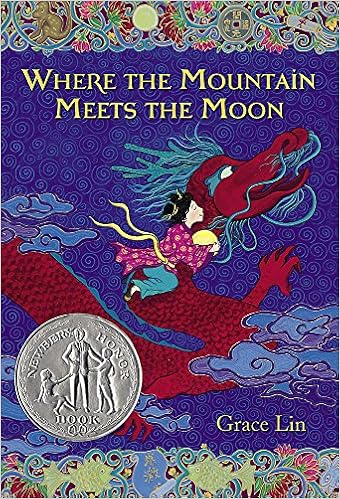
Where the Mountain Meets the Moon

Image result for where the mountain meets the moon

June 20, 2018

Where the Mountain Meets the Moon by Grace Lin

Literary Awards: Newberry Honor Book Award (2010)

Focus: Modern Fantasy

About the Author

Grace Lin

Grace Lin loved to read and write books since she was a child. Her parents were immigrants from Taiwan and at home, her family followed customs from Taiwan, though they generally spoke English. By the age of eleven, Lin fully disregarded her Asian heritage but her mother left Chinese folktale and fairy-tale books on the bookshelf as a way to try to engage Grace in her native culture. Eventually she read these and began to add her own details to the stories. Over time, she began to embrace her roots and visited Hong Kong, Taiwan and China to deepen her knowledge of the stories she had read.  Where the Mountain Meets the Moon  is a fantasy story inspired by the Chinese folktales she loved as a child. Grace studied art in college. Grace has written and illustrated many other books for kids. She currently lives in Somerville, Massachusetts with her husband Alex.

Summary

In the valley of the valley of Fruitless Mountain, a young girl named Minli lives in a village that was hard, poor and a shade of faded brown. Nothing grew on Fruitless Mountain, thus its name. In contrast to the brown is Minli, who has a lively and impulsive spirit. She lives in a small hut with her parents Ba and Ma. Ba, a kind, caring man tells stories every night at dinner. These stories inspire Minli and give her hope for a life beyond the mud and intense labor of village life. But, Ma is resentful of the stories  and feels they make Minli impractical and cause her to daydream. Ma’s bitterness shows when she says “Our house is bare and our rice hardly fills our bowls, but we have plenty of stories.” Ma sighed again. “What a poor fortune we have” (pg 10). Ma sees no joy in their lives, only pain and suffering. 

Throughout the book, characters share the legends and tales that have been passed down from generation to generation. These are always formatted differently. Notice how the author uses color, font and illustrations to bring the reader into the enchanting story being told. At the end of the book, we see how all these stories are intertwined for a surprising conclusion. 

Minli internalizes her mother’s attitude. She thinks “Ma is right. What a poor fortune we have. Every day, Ba and Ma work and work and we still have nothing. I wish I could change our fortune” (pg 12). Here is where Minli embarks on a heroine’s journey to find the Old Man of the Moon and ask him how her family can change their fortune. She is called to adventure by a magical goldfish she buys who tells her she can tell her the way to Never-Ending Mountain (where the Old Man of the Moon lives). And so Minli embarks upon a journey to help her family. Here, we see the story depart along two paths; one story telling of Minli’s journey, the other of her parents.

As Ba and Ma find Minli gone, Ma blames Ba for filling Minli’s head with stories. Ba is crushed and scared for his daughter. Their neighbors tell them “You better go find her or else she will never return. Foolish Minli! She is trying to do the impossible.” And so, Ba and Ma follow footprints in the woods to try to find their daughter.

At this point in the story, Minli has crossed the threshold into a world that is no longer safe and secure. As she goes deeper into the forest, she is met with a most unusual sight; a dragon tied up and sinking in a lake of his own tears. Minli frees the creature and finds out he was “born” through a magical painting brought to life and was tied up by vicious monkeys who would not let him pass through the peach grove. The dragon is devastated by the fact that he cannot fly. Minli offers him the opportunity to join her on her journey in order to ask The Old Man on the Moon why he cannot fly. Dragon accepts and becomes Minli’s protective figure.

Screen Shot 2018-06-21 at 4.13.06 PM


Along her quest, Minli meets many magical creatures and must survive many trials in this new environment. She must use her quick thinking and wit to get past the monkeys of the peach grove and meet the King of the City of Bright Moonlight in order to get the “borrowed line” goldfish told her she would need. Ba and Ma have decided to return home after meeting the mysterious man who sold Minli the goldfish in the woods. Ba tells Ma the story of the paper of happiness and says “So, I think like Minli, the secret word and the paper of happiness is not meant to be found.” They return home to anxiously await Minli’s return.

Every turn of Minli’s journey is fraught with danger and new friends, some even magical. As she meets these new friends, she starts to feel loneliness in the absence of her Ba and Ma. She also starts to feel shame when she realizes that maybe their lives were not as horrible as she thought. In a moment of pure fear, Minli is met by the evil Green Tiger who plagues the land. The Tiger tries to kill Minli, but Dragon saves her. The Green Tiger’s poison almost kills Dragon, but a special family from the Village of the Moon Rain is able to save Dragon. This family leads Minli to the final leg of her journey to reach the Old Man on the Moon.

As soon as Minli reaches the end of the bridge, she learns many things. All the enchanting tales and people we have met along the way start to connect in most surprising ways. As Minli reaches the Old Man of the Moon, he tells her, “Every ninety-nine years, someone comes here with their questions. But I will only answer one. So choose your question carefully” (pg 248). Such a dilemma!  Minli has promised dragon she will ask why he can’t fly, but she also needs to know how to change her family’s fortune. In this moment, we see Minli mature and become a whole person. She asks why Dragon cannot fly. Upon hearing this, Dragon is stunned. But, Minli knew she no longer needed to ask how to change her families fortune because she understood fortune was not a house full of gold and jade, but something much more. Something she already had and did not need to change. Dragon flies her home to her family where Minli completes the last stage of the heroine’s journey; the heroine’s return home.

By bringing Dragon back to Fruitless Mountain, Minli has fulfilled an old prophecy. This changed everything. Fruitless Mountain turned green, and the Jade river ran clear. Fruitless Mountain became Fruitful mountain and Minli and her family reveled in the joy of family and friendship. 

Screen Shot 2018-06-21 at 4.13.20 PM

Minli has changed many people’s fate by daring to do the impossible. A true heroine.


Author’s Use of Language

Tunnel et. al state “One of the great pleasures of language is to find in this fertile and varied vocabulary precisely the right word to use in exactly the right place” (pg 26). This statement best describes Lin’s writing; her use of precise language transforms us to different worlds and introduces us to dynamic, unique characters. For example, on page 112, we read this description of buffalo boy’s friend: “Even with the buffalo boy blocking most of her view, Minli could see his friend was beautiful, even more beautiful than he had described her. She seemed to glow like a pearl in the moonlight and her deep blue silk dress seemed to be the same color as the sky. The bag she held in her graceful hand seemed to be made out of the same silk, but the silver thread embroidered on it made it look as if it were made from a piece of star-scattered sky. Everything about her seemed finer and more delicate than the average person.” Even though it is never stated, from this description we can infer that this girl is special somehow. Her ethereal qualities foreshadow her importance; we know we will meet this girl again in the story and she will play an important role.

At another part of the story, Minli meets the King of the City of Bright Moonlight and awaits to see if he will give her the page from the Book of Fortune. Notice how Lin is able to build suspense with her use of precise language in the  following lines: “The King’s words seemed to hang in the air. All was silent except for the soft rustling of the page in the gentle breeze. Minli, unable to speak, watched it flutter as if it were waving at her. The moon seemed to tremble as ripples spread over its reflection caught in the water. The king continued, again, speaking more to himself than Minli. A wind skimmed the water, and Minli could see her anxious face as pale and white as the moon reflected in it” (pgs140-141). As I read this scene, I noticed I was literally holding my breath. What caused this reaction? Lin plays on all our senses without having to go into wordy description. With a line as simple as “A wind skimmed the water,” we feel the weight of the moment; everything stops and we notice the small things because time stands still. We don’t know for sure the King will give Minli the page, but we wait on the edge of our seats to find out.

In Minli’s first encounter with the Green Tiger, Lin uses figurative language and precise language to convey the dangerous intentions of the Green Tiger. She describes him on page 163. “The tiger glared like a spoiled child. Minli could now see it was no ordinary tiger. It was bigger than a horse or buffalo and it was a dark, dusty green like the color of sand dirtied from ocean foam. Even in the dim light of the moon, Minli could see it eyes glower with malevolence.” From this beautifully constructed sentence, I feel a shiver go down my spine alerting me to the fact that Minli is in the presence of pure evil. Lin continues to evoke strong reactions to the story by combining the use of figurative language with strong, precise word choice.

Lesson Ideas:

I would absolutely use this book with middle school students to teach the motif of heroism that is present in modern fantasy stories. Previously, I have used The Lightning Thief  by Rick Riordan as the mentor text for this unit. However, after reading Where the Mountain Meets the Moon, I think students would have an easier time understanding the plot and characters more with this story. Again, Lin’s use of precise vocabulary and figurative language creates depth of character and plot in a straightforward manner. Each character is introduced with an accompanying backstory, allowing students to grasp their connections later in the story.

Below are some resources I used with middle school students to teach the Heroine/Hero’s Journey in literature. I would adapt these to fit Where the Mountain Meets the Moon.

  • Resource #1: Heroine/Hero’s Journey Supplementary Text- This text provides students background knowledge of the hero’s journey in literature and uses a graphic to illustrate the stages or elements present in a story.

Hero’s Journey Supplementary Text

  • Resource #2: Heroine/Hero’s Journey Map Template- This is a graphic organizer students can use to analyze and visually represent the hero’s journey in the text

Hero’s Journey Map Template

  • Resource #3: Heroine/Hero’s Journey Narrative Writing Packet- Students can use their knowledge of the genre to write their own story as a modern fantasy narrative. 

Hero’s Journey Narrative Planning Packet

Mentor Text

Where the Mountain Meets the Moon is a wonderful mentor text to teach theme, character development and a genre study of modern fantasy; particularly through analysis of the heroine/hero’s journey. These are all common core standards present in middle school curriculum.  The text also provides students the opportunity to use the story to create their own modern fantasy narrative using Lin’s writing as an example.

Looking Beyond the Text 

In chapter 10, Tunnel et al. state, “Good fantasy actually tells the truth about life. It clarifies the human condition and captures the essence of our deepest emotions, dreams, hopes and fears” (pg. 130). This is especially true of Where the Mountain Meets the Moon. There are so many life lessons present in the story such as what defines happiness, how to find happiness despite one’s circumstances, the importance of family and friendship as well as the motivating power of greed. These are themes middle school students can connect with as it is the essence of what they deal with in their personal life on a daily basis. I found the change in Ma to be one that was especially powerful. Towards the end of the book, she tells Ba a story of a woman who was so dissatisfied with life, she didn’t even miss what was important until it was gone. Ma’s ability to reflect on her own actions and how these actions effected the people around her in a profound way and accept responsibility for those actions is something I know students could take meaning from. Often I see students think that the damage they have done to relationships is unfixable and not worth trying to repair. Ma’s story teaches them otherwise.

Before Reading

I have no concerns in sharing this book with students.  Before reading Where the Mountain Meets the Moon, I would have students delve into some of the Chinese fairy tales and folktales Lin was inspired to use for the book. This will provide students background knowledge on these types of stories to better help them understand and analyze them. Students can then make text to text connections as they read as well. I would also share with them the Author’s Note with them before delving into this unit. Again, I think this will help students make a personal connection to the author as many of them can empathize and understand how hard it is to be a part different cultures. Reading about Lin’s experience growing up and her passion for the genre is a great way to hook students interests before beginning the unit.

Q & A

  1. Who has the power? How is the power shown?

In the story, I believe each character has the power over themselves and their choices; it’s just a matter of realizing this. Some characters are very aware of the power that lies within such as buffalo boy. Buffalo boy is alone and lives in very humble conditions. But, he feels no anger or self-pity towards his situation. He is content and happy with what he has; a roof over his head, a water buffalo for company and a mysterious friend who warms his heart with love. He chooses to believe in his own self-power. Ye Ye is another character who is aware of his own self-power. Even when his family is threatened and sure to be destroyed by the magistrate, Ye Ye says, “Sons and daughters, prepare the finest picnic you can, with enough food and tea for all. We will not waste this time we have together. We will spend it as we always have, in happiness.” In this situation, the magistrate appears to have all the power, but Ye Ye shows otherwise. He does not bend to the magistrate’s demands and instead shows true power. In contrast, Ma believes she has no power; her situation is one that was done to her and until the end of the story, she believed she had no power to change. She didn’t believe Minli could change it either, but Minli showed her the power of of believing in oneself to bring about change.

2. What attitudes are shown toward people, animals, and even the land?

One attitude Lin displays is the belief that all of us humans, animals, nature and the land are connected. We all play a role in each other’s destinies and so it is important to respect and honor each other. She also shows the attitude that people’s desire for material wealth and power are their greatest downfall. Minli tricked the monkeys by playing on their greed. We see this again in the story of Wu Kang; a man who was never satisfied and now is fated to spend his life trying to learn how to be patient and content. Green Tiger was also tricked to his death because his searing anger blinded him to the truth.

3. Within the short story, many characters undergo a change from the beginning to the end of the story. Which character do you think showed the biggest change from the beginning to the end of the story?

Personally, I feel like Ma was the character most impacted and changed in the story. At the beginning of the story, she was so discontent that she made her entire family struggle to find happiness. Minli was so affected by her mother’s constant sighs and frustration that she took it upon herself to find a way to change the families fortune. Ma also treats Ba horribly though he shows her nothing but kindness and understanding. When they find Minli has gone, Ma blames Ba saying “It is all the stories you told her,” Ma sobbed. “She believed them now and is looking for fairy tales. Her words cut into Ba like slices from a knife…” Ma has no regard for Ba’s feelings but uses him as a punching bag for her unhappiness. At the end of the story, Ma realizes that all along she had been longing for treasures, but she already had the most precious thing; a daughter and husband who loved her. She begs forgiveness for her actions and moves on to become a satisfied, happy woman no longer concerned with material wealth.

References:

Tunnell,M. Jacobs, Young, T., Bryan, G. (2016). Children’s Literature, Briefly (6th ed.). New Jersey: Pearson.


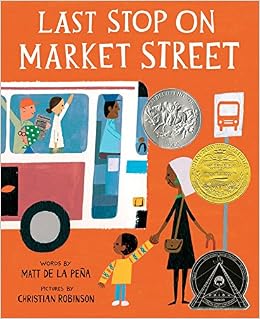
Last Stop on Market Street

Image result for last stop on market street

June 19, 2018

Last Stop on Market Street by Matt De La Pená

Illustrated by Christian Robinson

Literary Awards: Newberry Medal Award (2016), Caldecott Honor Book Award (2016), Coretta Scott King Illustrator Honor Book (2016),A New York Times Book Review Notable Children’s Book of 2015,A Wall Street Journal Best Children’s Book of 2015

Focus: Contemporary Realistic Fiction

About the Author

Image result for matt de la pena biography

Matt De La Pená is a Newberry honor award winning author who has written six young adult novels and four picture books. Matt’s book Ball Don’t Lie was made into a major motion picture. Matt’s picture book Miguel and the Grand Harmony was released by Disney in both English and Spanish. This book is a tie-in for Pixar’s blockbuster hit Coco. In 2012, Tucson schools banned the use of Matt’s book Mexican Whiteboy as part of the curriculum.  When visiting Tucson high school students, Matt shared about himself. He told students “his story of reluctant reader to successful writer. He explained that, half-Mexican, half-white, he had grown up speaking no Spanish; too white for Mexican kids, too brown for whites” (Winerip, 2012). In 2016, Matt was awarded the NCTE Intellectual Freedom Award for his work. Matt attended the University of Pacific on a full basketball scholarship. He received his MFA in creative writing from San Diego State University. He currently lives in Brooklyn, New York and teaches writing. He also visits high schools and colleges throughout the  country.

Summary

Every Sunday after church, CJ and his grandmother ride the bus across town to their stop on Market Street. On this rainy Sunday, CJ wonders why they have to ride the bus in “all this wet” when his friends have cars to ride in. CJ’s Nana responds by pointing out that if they didn’t ride the bus, they would miss the fun tricks of Mr. Dennis.  As they ride along, CJ continues to notice and wonder about differences he sees around him. He wonders why he always has to go to the soup kitchen after church when his friends don’t. He wonders why he doesn’t have an iPod, why some people are blind and why the area around the soup kitchen is so dirty. At one point while staring out the window, CJ feels sorry for himself when thinking about these things. But, CJ’s Nana is a special woman. To each of CJ’s questions, she has an answer that shows CJ the magic and beauty present in their everyday life. By the end of the story, CJ realizes this magic as well.

Screen Shot 2018-06-19 at 9.50.49 AM.png

This Sunday’s bus ride to Market Street proves to be special as CJ’s Grandma opens his eyes to the beauty of his world; a beauty he didn’t previously see. 

Author’s Use of Language

Tunnel et. al (2016) state “Life like good stories contain occasional small surprises. We live with characters as they work their way through problems but may be delighted suddenly by an eye-opening insight about the human experience that comes from their struggles” (pg 30). In Last Stop on Market Street, the grandmother character provides these unexpected insights for the reader. When CJ asks why his friends never have to go to the soup kitchen, Nana responds by saying “I feel sorry for those boys. They’ll never get a chance to meet Bobo or the Sunglass Man. And, I hear Trixie got herself a brand-new hat.” In this moment, the author could have chosen to hit us over the head with a lesson; instead, he chooses understatement which is far more powerful. Because of this, we see that relationships with people can bring much joy, even if it is a small thing (like Trixie’s new hat). These relationships are precious and we should seek them out. As CJ begins to internalize the magic in his grandmother’s insights, we see the author’s use of imagery, figurative language and music in language combine (see the page below). In turn, I as the reader am filled with emotion as I too internalize Nana’s words and the meaning behind them.

unnamed-1.jpg

Notice how in the page that follows this one (see below), both CJ and the reader are snapped right back to reality. Gone are the dreamy, cool colors that create this beautiful, magical moment where metaphorically CJ is “lifted out of the bus.” No longer do we hear the music of the man’s guitar. Both the text and the corresponding image bring us sharply back to the present, but we carry the message with us. 

Screen Shot 2018-06-19 at 10.13.37 AM.png


Lesson Ideas: 

In the article Critical Literacy as Comprehension, McLaughlin and DeVoogd (2004) state, “Critical literacy helps teachers and students expand their reasoning, seek out multiple perspectives and become active thinkers”(pg. 52). The Last Stop on Market Street is a wonderful book to use to engage students with the four dimensions of critical literacy. Having students analyze why the author wrote this book, examining the language used to achieve his purpose and interrogating both text and illustrations would allow them the opportunity to both read and reflect on issues of race, class, poverty and homelessness.

Below is a link to a website I frequently use when approaching planning for critical literacy in the classroom (as I still am very much a novice). This website is an award winning website called Teaching Children Philosophy. The website provides a comprehensive list of questions to use in order to plan and guide students through the four dimensions of critical literacy and is adaptable for any grade level. For me, this is a place to start as I often find the hardest part of planning for critical literacy is coming up with meaningful questions to best guide and scaffold students’ critical thinking.  I have found this website to be an amazing resource.

Critical Literacy Discussion Questions & Activity Ideas

The images themselves give students much to analyze and contemplate as they seek to “know the author’s intent, to understand the sociocultural influences, and comprehend with a critical edge” (McLaughlin & DeVoogd, 2004 pg. 52).

Mentor Text

While I feel like Last Stop on Market Street would be a strong text for any grade level, I would use it with my seventh grade students to analyze how the author develops and contrasts the points of view of different characters in the book as well as the narrator. Students can analyze CJ and his grandmother as well as the language the author uses to describe both in an “effort to use background knowledge to understand the relationships between their ideas and the ideas presented by the author of the text”(McLaughlin & DeVoogd, 2004 pg. 53) and read from a critical stance.

Looking Beyond the Text

For students, I think the social issue presented in the text is one they will find a strong connection to. Daily I see students struggle with the idea of “have vs. have not.” In our school, shoes and phones play a big role in students “status” within the community. This is a constant struggle for some students who I know have asked the same question as CJ; “why do some people have things I don’t?” The sense of inferiority that some students feel because of their socioeconomic status, race or culture causes them great distress and often makes them feel ostracized within the social community of the school. Last Stop on Market Street includes many topics students can unpack in order to think deeply about their own biases, actions and roles within the community.

Before Reading

I would not have any concerns sharing this book with students, but before reading I would want to give them time to independently explore their thoughts feelings around the topics of what it means to be different, equality and happiness. I would ask them to respond in writing to one question about each topic as a way to activate background knowledge and make connections to the text as we read. In exploring their own thoughts on these topics beforehand, hopefully students will feel more comfortable engaging in the post reading discussion and have a way to go back and see if their thinking was changed by interacting with the text and their peers.

Q & A

  1. What do you notice about stereotypes?

In looking closely at the images, it appears the author and illustrator took care to make sure all the characters represented a mix of race and socioeconomic status. For instance, Colby’s family (who has a car) is white. On the bus, there is a mix of races represented. One man has tattoos, an older woman wears a headscarf and mismatched socks, and a blind man wears a full suit. The two boys who get on the bus and are sharing an ipod are mixed race. At the soup kitchen, we see a mix of races as well. This challenges stereotypes because it is presented that all people have different things; these are not necessarily better or worse, just different with their own advantages and disadvantages.

2. What attitudes are shown toward people, animals, and even the land?

One attitude that comes across clearly through Nana’s character is that we don’t necessarily need money and objects to be happy. The grandmother seems truly content and happy with what she has. Furthermore, she seems to focus on this as opposed to wasting time and energy worrying about what she doesn’t have. This attitude comes through in the short but thoughtful responses grandmother gives in response to CJ’s wonderings. For example, when CJ asks “Why we gotta wait for the bus in all this wet,” grandmother replies “Trees get thirsty, too. Don’t you see that big one drinking through the straw?” She doesn’t scold or belittle CJ, just offers up a metaphor that illustrates how beautiful and necessary rain is. She lets her comment hang instead of elaborating to allow CJ to figure the meaning out for himself. The other characters on the bus also reflect this attitude of “be happy with what you have.” There is a feeling of connection on the bus as people respond to Nana and share with CJ their positive outlook on life.

3. How are family relationships depicted?

The strong relationship between Nana and CJ depicts a strong familial relationship. We see this further in the Sunday routine they have of church, bus ride and volunteering at the soup kitchen. There is a sense of mutual respect as Nana always responds to CJ’s comments with honesty and positivity. CJ  continues to ask questions about the things that bother him. This shows he feels heard and understood by Nana and trusts she will give him an answer to his questions. CJ seems to enjoy spending time with his Nana, even if he isn’t always thrilled by the activities they do together. They have a bond; this is evident in the way CJ thinks he knows Nana well enough event to predict how she will respond in a given situation. For example, after he states how happy his is to be at the soup kitchen, he says “He thought his nana might laugh, but she didn’t. She patted him on the head and told him, ‘Me too CJ. Now, come on.” Even though the language used to describe this relationship is simple and much is left up to the reader to infer, we know how important family is to both characters in the story.

References:

McLaughlin, M., DeVoogd,G. (2004). Critical literacy as comprehension: Expanding reader response. Journal of Adolescent and Adult Literacy, 48 (1), pgs. 52-62. doi: 10.1598

Tunnell,M. Jacobs, Young, T., Bryan, G. (2016). Children’s Literature, Briefly (6th ed.). New Jersey: Pearson.

Wartenberg, T. (2018). Last Stop on Market Street. Teaching Children Philosophy. Retrieved from https://www.teachingchildrenphilosophy.org/BookModule/LastStop.

Winerip, M. (2012). Racial Lens Used to Cull Curriculum in Arizona. New York Times. Retrieved from https://www.nytimes.com/2012/03/19/education/racial-lens-used-to-cull-curriculum-in-arizona.html?pagewanted=all&_r=1&


El Deafo

Image result for el deafo

June 17, 2018

El Deafo by Cece Bell

Color by David Lasky

Literary Awards: Newberry Honor Award, Eisner Award

Focus: Graphic Novel Memoir

About the Author

Image result for cece bell

Cece Bell grew up in Salem, Virgina. She lives in an old church in Virgina and uses the barn next door as her writing studio.  While attending the College of William and Mary, she met her husband Tom Angleberger. They were both art majors. Bell went on to get a graduate degree in illustration and design at Kent State University. She has worked as a freelance illustrator for a variety of projects, but currently is a full-time author and illustrator. She has written many books for children. One of her most popular series is The Sock Monkey series. Cece often travels around the country visiting schools, inviting students to participate in a play version of the book and sharing the original stuffed animals that sparked the series. She also teaches students how to draw some of the characters from the books. She has collaborated and worked with her husband as well to create Crankee Doodle and the Inspector Flytrap series.

Summary

At the beginning of the story, the main character Cece gets sick with meningitis. After spending a long time in the hospital, Cece finally gets to go home. One day Cece is playing and loses her mom in the house. This scares her and confirms Cece’s belief that something is different. On page 12 she says, “When I finally found her, I know that everything is different. I think she knows it too.”

Screen Shot 2018-06-17 at 6.41.28 PM.png

At this point in the story, the author allows the reader to infer that Cece can’t hear. Throughout the book, she often uses blank speech bubbles to illustrate Cece’s inability to hear what is going on around her.

After some testing, Cece learns that she is deaf. Her doctor gives her a hearing aid that will help her hear. For the first time since she has been home from the hospital, Cece can hear sound!

Screen Shot 2018-06-17 at 6.47.16 PM.png

This graphic conveys to the reader what Cece’s first experience hearing with the aid was like. We can experience how overwhelmed she is in that moment by her facial expression and the jumble of words in the background.

As Cece prepares to start kindergarten with her new hearing aid, she worries about being seen as different. But, when she gets to her new school, she sees that all the students wear hearing aids. At this school, Dorn (her teacher) teaches her how to use the sound from her hearing aid, visual cues and lip reading to make sense of what people are saying. Cece loves school and learning, but finds out it is still remarkably hard to understand people. And, she still worries a great deal about being different.

That summer, Cece’s family moves. Cece starts to notice that kids think that if they just talk louder and slower, it will help her hear. This is a frustrating pattern that will continue to repeat itself as she interacts with new kids.

Screen Shot 2018-06-17 at 7.02.12 PM.png Screen Shot 2018-06-17 at 7.02.59 PM.png

Notice how Cece responds to kids who don’t understand how to communicate with her. She shares what she wants to say and what she actually says. Throughout the book, we see this pattern of behavior. She doesn’t educate the kids and explain what would really help her for fear of being seen as different. Instead, she just pretends it helps. 

In Cece’s new town, there isn’t a school for the deaf. So, Cece is given a new phonic ear device to help her hear better in school.

Screen Shot 2018-06-17 at 7.07.58 PM.png

The phonic ear works great! So great, in fact, that Cece can hear her teacher even when she is not in the classroom. Cece considers this her new superpower that she will use to impress all her classmates. But, Cece feels like she lives in a “bubble of lonlieness.” Always a little different, always alone. As she goes through school, Cece makes a series of friends and tries to navigate how to be herself in her relationships. This is not always easy and often leaves her wondering if it is better to just be alone.

Screen Shot 2018-06-17 at 7.15.08 PM.png

Cece’s best friend in third grade is Ginny. Ginny talks slow and loud, which really bothers Cece.

Cece says, “School. Friends. No friends. The Phonic Ear. It’s all so exhausting. I need a break. So, I watch t.v.”  Even though she can’t really understand what’s happening in the shows, for awhile she finds this easier than dealing with people. One night while she is watching an ABC after school special about a girl who was deaf, Cece embraces the name “El Deafo” as her way to cope with feelings of anger, loneliness and frustration.

During her fourth grade year, Cece’s phonic ear breaks and it is going to take awhile to replace. She finds she is unable to get what she needs in school without it. Her mom tries really hard to get Cece to learn sign language as way to communicate without always having to rely on the phonic ear. Cece rejects this because she worries what people will think if they see her signing.

In fifth grade, Cece makes a new friend named Mike Miller. She has a huge crush on him. He stands up for her and changes everything when he shares with the other students how cool her phonic ear is. Kids are amazed to see how far the phonic ear picks up sound and that Cece can hear teachers even when they aren’t in the classroom.

Screen Shot 2018-06-17 at 7.38.57 PM.png

For the first time, Cece feels truly accepted by her peers for exactly who she is. 

Cece now faces a moral dilema; Mike has asked her to use her “superpower” to have some fun in the classroom. Everyday the teacher leaves the classroom for quiet math time. Students are expected to work independently and quietly at this time. Mike tells Cece that since she can hear the teacher, she can warn them when the teacher is coming back so they can party. Cece decides to do this and is considered a hero by her classmates when it works perfectly. This leads Cece to feel like she is a real part of her classroom community. This gives her the confidence to repair her friendship with Martha, a true friend.

Author’s Use of Language

One of the most powerful aspects of El Deafo is Bell’s use of extended metaphor to allow the reader to see inside the main characters inner thoughts. When Cece is feeling particularly low or high, she assumes the role of “El Deafo,” her inner superhero. During these parts in the book, her most intimate thoughts are revealed. This helps the reader form a relationship with the main character because she shares her feelings with us uncensored; there are no secrets between reader and character.

Screen Shot 2018-06-17 at 7.55.54 PM.png

In the scene above, Cece revels how she really feels about her first grade friend Laura. As The scene is a little dark and vengeful, but this assumes there is a level of trust shared between the main character and the reader. The author feels safe enough to share her true feelings, even though it may not be what we expect. 

Screen Shot 2018-06-17 at 8.01.06 PM.png

In this scene, we once again see how Cece really feels about Mike and the type of relationship she wishes she had with him. 

Screen Shot 2018-06-17 at 9.19.03 PM.png

Cece uses the metaphor of “living in a bubble” to explain how her life feels. She is apart of things, but there is always something keeping her separate from others. 

 Lesson Ideas

With adolescent students, El Deafo is a wonderful text to use for character analysis because we see so many different sides of the character. Below is a graphic organizer I have used to help guide students thinking as they formulate their ideas about the character. An important element of this organizer is students must note the textual evidence that verifies their analysis of the character. It also pushes them to consider all the dimensions presented in the text (graphics, dialogue, narration).

analyzingcharacters

Writing Extension: After students have read El Deafo and analyzed the main character, I would have them create their own “super hero self.” Through writing and drawing, students could communicate who they see themselves as and explore their own insecurities and friendships. I would preface this activity by letting students know it is not something to be shared with the class to ensure honest participation in the activity. I anticipate this would be challenging for students to start, but would flow once they got started and began to engage in their writing and creating.

Mentor Text

El Deafo would be a strong mentor text to use in a seventh grade unit focused on character analysis. I also think this would be a strong text to use as a model for students as they consider the format they want to use to write their own personal narrative. Bell provides a strong example of the power of graphics and how much a writer can communicate to their audience by using them alongside text.

Looking Beyond the Text

In the story, Cece is plagued by her deep concern of what people think of her. This leads to crippling self-doubt and toxic friendships. Often, seventh graders are consumed by their social world and struggle to build lasting, positive relationships because they too are concerned with “fitting in”. Cece Bell’s bravery in sharing her story would inspire students. This text opens the door for students to really examine their own friendships and the effect these relationships have on them (either positively or negatively). Using the characters from the story allows them to discuss freely without fear. For example, students could reflect on a time they were a friend like “Laura” or had a friend like her and compare what that was like versus having a friend like “Marsha.” Further discussion questions could include: “What should Cece have done when Ginny talked to her in a way that made her feel bad?” Hopefully, by participating in the reading and analysis of El Deafo, students can have real world transfer to their own friendships and relationships.

Before Reading

One of my biggest concerns about sharing this book with students is Cece’s attitude towards learning ASL (American Sign Language). I have many students who speak English as their second language. We work hard to help students feel that their first language is valued, even if it isn’t the predominant language used in an academic setting. Students are proud to be bilingual. In El Deafo, ASL is talked about with negative connotation. Cece calls her ASL classes “dumb” and talks about how stupid ASL is and how miserable she is having to learn the language. At one point, she says, “And as far as “helping” it’ll help people stare at me, is what it’ll do!  Look at that deaf girl!  Isn’t she special!” Then, she sees a couple using ASL to communicate in a restaurant and confirms that it just makes people stare. It would be important to talk with students about how this was one person’s experience, but that one person’s opinion doesn’t reflect an entire community’s feelings.

Q & A

1. What do you notice about stereotypes?

In El Deafo, Bell brings up many stereotypes about people who are deaf. For example, she talks about how people think speaking slowly and more loudly helps someone who is deaf understand what you are saying when in fact, this makes it harder. Below is a very simple graphic organizer I have used with students to further unpack stereotypes mentioned in text. In using this with El Deafo,I would provide some supplementary text as a way for students to be exposed to unbiased information regarding the stereotypes and realities so they are not just getting all their information from one source.

Stereotype vs. Reality

2. Who has the power? How is this power shown?

Throughout most of the story, the power lies with Cece’s peers and friends. Cece gives them the power because she is too scared to be unique or different. At one point in the story, Cece joins the Girl Scouts with Laura. She has a great time and makes some new friends who she feels she can be herself around. They invite Cece to spend the night and try to form a relationship with her, but Cece says “But I’m not allowed to keep new people.” Here, she is giving Laura the power to decide her friendships for her. Cece does this again with Ginny. She knows there is a major issue in the relationship, but instead of having a communicative conversation about her feelings, Cece just lets her feelings of resentment grow until she blurts out how she feels. Ginny responds by terminating the friendship; which Cece doesn’t challenge. She allows herself to be treated a certain way because she doesn’t seek a balance of power in her relationships. This changes at the end of the story when she seeks to find equal balance in her relationship with Marsha.

3. Was it ethical for Cece to use her Phonic Ear to monitor her teacher’s movements? By asking her to do this, is Mike a good friend to her?

These are two questions I would love for students to consider. Personally, I don’t think it was ethical for Cece to use her Phonic Ear in this manner. It is debatable because the teacher also left the students alone for an extended period of time, but ultimately Cece knew this request was wrong and her initial reaction was that it would be trouble. But, she would do anything for Mike Miller. In asking her to do this, Mike doesn’t seem to just be “using” Cece. He seems to care for her in a real sense and want to be her friend. When he first shares his plan with Cece, he tells her she would be a “real hero” for doing this. So, he seems to want to give her a way to fit in and be liked. But, would a real friend ask her to do something that was morally wrong and would get her into big trouble if caught?


A Long Walk to Water

Image result for a long walk to water

June 13, 2018

A Long Walk to Water: Based on a True Story by Linda Sue Park

Literary Awards: Jane Addams Children’s Book Award for Older Children (2011), Flicker Tale Children’s Book Award Nominee for Juvenile (2012), Pennsylvania Young Readers’ Choice Award Nominee for Grades 6-8 (2013), Rebecca Caudill Young Readers’ Book Award Nominee (2015)

Focus: Contemporary Realistic Fiction

About the Author

Linda-Sue-Park.jpg

Linda Sue Park is a Korean American author of children’s fiction. She has been writing stories since she was in kindergarten. She attended Stanford University where she earned a degree in English. She was also a member of the gymnastics team. She furthered her studies in London and earned advanced degrees in literature at Trinity College and University of London. She is happily married and has two children. Park has had many different jobs including a public relations writer for a major oil company, working at an advertising agency, teaching ESL at the college level and writing as a food journalist. Throughout her busy life and many job changes, her love of writing flourished. Park currently lives back in the Unites States and continues to teach ESL. She mostly writes historical fiction and has written many books that explore Korean culture and history.

Summary

A Long Walk to Water tells the story of Nya (a fictional character) and Salva (the real person this story is based on). Both are children living in Sudan at different times.

Salva is a member of the Dinka tribe and his story is set in 1985 when rebels from the southern part of Sudan, where he and his family lived, were fighting against the government, which was based in the north. As Salva’s story begins, the war has reached his village. As gunfire rings throughout the village, he is forced to run into the bush, away from the home he has know all his life. This day changes Salva’s life forever. He is forced to walk thousands of miles across the country in an attempt to find his family and reach safety. At one point, Salva meets an old woman who says, “A bad thing this war. What are you going to do-how will you find them?” Salva had no answer. He had hoped that the woman might have some answers for him; after all, she was an adult. Instead, she had only questions. Everything was upside down” (page 17). Salva realizes it is up to him to take care of himself.

Along Salva’s journey, he experiences debilitating hunger, exhaustion and fear. He makes a new friend named Marial, and is joyously reunited with his Uncle. As leader of the group, Salva’s uncle is able to provide the boys protection and nourishment. Together with a group of people, they must face the most difficult part of their journey: the Akobo desert. Before they begin their journey, Marial dies, causing Salva much fear and sadness. But, there is no choice but to endure the brutal journey ahead. “The first day in the desert felt like the longest day Salva had ever lived through. Each minute walking in that arid heat felt like an hour. Even breathing became and effort” (page 52). In a moment of despair, Salva gives up; unable to take the physical and mental strain of walking. His uncle gives him a strategy he will use for the rest of his life; just take one step at a time and keep moving forward. Sadly, Salva’s uncle is murdered by a member of a rival tribe, the Nuer. Salva finds a strength he never knew he had after his uncle’s death and continues to fight for his survival. After weeks of walking, he reaches the Itang refugee camp in Ethiopia.

Life in the refugee camp is miserable. But, using his uncle’s strategy, Salva gets through one day at a time. He lives in this camp for six years this way. One day, the camp is violently evacuated by soldiers and Salva once again is forced to embark on another dangerous journey to a refugee camp in Kenya. Salva becomes the leader of the group of people traveling with him. Every day, he tells himself and the boys in his group “One step at a time, one day at a time. Just today- just this day to get through.” A year and a half later, he leads 1,200 boys safely to the Kenyan refugee camp.

Nya’s story is set in 2009. A member of the Nuer tribe, her people’s struggle for clean drinking water is a daily battle. Nya spends each day laboriously fetching water from a pond two hour’s walk away. Her younger sister almost dies from drinking contaminated water. Then one day, visitors show up in the village and start clearing the land. They bring an “iron giraffe” into the village, which was new and strange to the villagers. Nya wonders what this “iron giraffe” has to do with water. After days of drilling, her question is answered when new water comes out of the hole. Here, we see Salva and Nya’s stories intersect.

After years in the Kenyan refugee camp, Salva had the opportunity to go to America and was adopted by a new family. He studied and worked hard in order to achieve his dream; helping bring water to the villages in Sudan. He leads the crew of the workers building the well in Nya’s village. She finds the bravery to walk up and thank him for bringing the water and learns his name is Salva.

Author’s Use of Language

  • Figurative language: Throughout the story, Park uses figurative language to help the reader imagine the unimaginable. On page 8, she describes the bombing of Salva’s village by saying,“Overhead a jet plane veered away like a sleek evil bird.” Later in the story, we feel Salva’s joy of finally having a meal that ended his violent hunger through the imagery of the metaphor “His belly was a rounded lump stuffed full of honey and beeswax” (page 28). Park also uses onomatopoeia to create drama in the story. On page 5, words such as “CRACK” and “POP” illustrate the sound of gunfire in the village. On page 83, we hear the satisfying “Whoosh” of water coming out of the new well in Nya’s village for the first time. 
  • Precise language: Description of Nya is often written in short, punctuated sentences for emphasis. On page 20, Park writes of Nya’s routine of walking to get water “Daily. Every single day.” Additionally on page 1 she writes, “Heat. Time. And thorns.” By doing this, Park makes the words more blunt in an effort to emphasize how hard this responsibility was for Nya.
  • Repetition of language: Throughout the story, we see Salva repeat the phrase, “A step at a time. One problem at a time- just figure out this one problem.” Salva says this each time he encounters an unfamiliar, challenging situation. The repetition of this phrase (or a version of it) helps the reader identify and understand a major theme of the novel.

Lesson Ideas

I will be using this book as an anchor text in my seventh grade language arts class this upcoming year. Below are some of my plans for implementation:

Unit 1: A Cultural Study of Sudan (Pre-war and Post-War)

During this unit, students will engage with a variety of text to learn about the culture of the Sudanese people both before and after the civil war. They will use “the cultural iceberg” protocol as a way to define “culture” and explore this new culture on a deep level. With this graphic, students are able to think about what aspects of culture are visible vs. which are not. As students learn about a new aspect of the culture, they add it to their cultural iceberg based on the category it represents. An example of this graphic organizer with some sample categories is below:

Related image

Unit 2: Personal Experience with Conflict

In this unit, students will read and analyze the book A Long Walk to Water to learn about Salva and Nya’s personal experience with conflict. Additionally, they will read excepts from A Long Way Gone to compare and contrast Salva’s experience to Ishmael’s and learn about the use of child soldiers in the war. They will create a new cultural icebergs and use the protocol to flush out the aspects of culture evident from the stories. This will guide their collection of text evidence to use when writing their essay and two-voice poems in a later unit.

Image result for a long way gone

There are many similarities between Salva and Ishmael’s stories. Looking at both will give students multiple perspectives and stories to consider.

This is another wonderful book that tells the story of eight year old Garang who also also trekked from Ethiopia to Kenya in an effort to escape the war. Students will find many parallels to Salva’s story.

Unit 3: Writing Focus 

In this unit, students will write a literary analysis essay about the theme of survival. Additionally, students will engage in a deep exploration of character and point of view by combining their research about Sudan with specific quotes from A Long Walk to Water to craft a two-voice poem, comparing and contrasting the points of view of the two main characters, Salva and Nya. The two-voice poem gives students an opportunity to use both their analysis of the characters, the theme of the novel and their research about the experiences of the people of Southern Sudan during the Second Sudanese Civil War.

Unit 4: Inquiry Project

In unit four, students will conduct research on children living in conflict in other parts of the world. They will read to understand what is causing the conflict and how this effects the people within the culture. They will continue their research to find an organization that seeks to help solve the problem. In groups, students will present their research on the culture of the people, the conflict they are experiencing and what we as global citizens can do to help. The class will choose the organization they are most passionate about supporting based on students presentations and find a way to contribute to the cause.

Mentor Text

A Long Way Gone is a wonderful text for students to read in order to explore and learn about the experiences of people of Southern Sudan during and after the Second Sudanese Civil War. Through the reading and analyzing of both the novel and additional text, students build proficiency in using textual evidence to support ideas in their writing and speaking. Students will read closely to practice citing evidence and drawing inferences from this compelling text as they begin to analyze and contrast the points of view of the two central characters, Salva and Nya. They also will read informational text to gather evidence on the perspectives of the Dinka and Nuer tribes of Southern Sudan (Engage New York, 2018).

Looking Beyond the Text

A Long Way Gone is a way for students to learn about different cultures and the conflicts different groups of people are facing in the world. It helps them look outside their own communities and lives to develop a world view. This book helps students build inter-cultural empathy; an essential element needed for them to grow up with awareness and sensitivity. This book is also a strong call to action. After reading the book, there are concrete ways students can get involved in trying to help change the situation for the people in Sudan. Salva is even trying to engage students in his efforts to bring clean water to the villages of Sudan by hosting an “iron horse challenge” through his organization, Water for South Sudan. This challenge encourages schools to try to raise $1,000, which is the cost of one well. Schools who complete the challenge are entered into a drawing to have Salva come visit with their school. This provides a real world context for students learning and also provides hope that things can change if people are willing to stand up and fight for that change.

Iron Giraffe Website Banner.jpg

Salva Dut is challenging students to get involved by raising money to drill a well in Southern Sudan. This is one way students can use their knowledge in a real world context.


Before Reading

This books has some very intense scenes that may be very difficult for students to read. For instance, in one part of the story Salva’s young friend dies from a supposed lion attack in the night. Additionally, his uncle is murdered at gun point by members of the Nuer tribe. Students will have a strong emotional reaction to this book and it will be necessary to preview the content before reading in order to prepare students for what is to come. Students will need strategies and techniques to use as they engage with the content and topic of A Long Walk to Water. It will also be important to provide students the opportunity to share individually with either the teacher or a mental health provider in the school if they are having a hard time processing their feelings and reactions to the text.

Q & A

1. What roles do women and girls have — based on their own intelligence or initiative or on good looks/relationships? how are problems presented, conceived, resolved?

Through Nya’s story, we learn about the roles of women in the Nuer tribe in South Sudan. It is Nya’s job as eldest daughter to provide water for the family each day. It is also part of her role to watch and take care of her younger sister and teach her how to fetch the water as this task will someday be hers as well. We get the sense from the book that women are the caretakers of the home and children. They are valued by the men for this role, but are not provided equal opportunity. Nya does not have the privilege of going to school, yet Salva does. At the end of the story, Nya learns that a new school is going to be built in the village and both girls and boys will be allowed to attend. Nya’s overwhelming joy at this is felt in the lines “Nya went back and picked up the plastic can. She felt as if she were flying. School! She would learn to read and write!” (pg 104).

2. Do depictions of all cultures avoid oversimplification or offer genuine insights?

For the most part, we encounter genuine insights about the different tribes represented in the book. Some of these insights come from memories Salva shares about his culture, his people and the war. I do feel like there is some oversimplification in regards to the Nuer tribe. I felt like I never understood the intricacies of the difference between this tribe and others. More depth would have helped me as the reader make sense of why the conflict existed and ran so deep, helping me better understand the motivations of some of the characters.

3. Why did Linda Sue Park to set the story in both 1985 and 2009?

According to Park, she did this to give American readers a sense of what was  happening in Sudan in the last generation. She thinks far too few Americans were aware of this tragedy and wanted to bring it to light in a way even young readers can understand. I think this was powerful and achieved her purpose. If she had just written the book as a biography about Salva, we wouldn’t be aware of the continued struggle for survival the people in south Sudan are experiencing. If this story was just about Salva, it would be easier to categorize his experience as an isolated event; interesting to know about but no call to action. So, the contrast of time and Nya’s story in the book is a necessary element to understanding the whole issue, not just part of it.

References

New York State Department of Education. (2018). Grade 7 English Language Arts Curriculum. Retrieved June 12, 2018 from https://www.engageny.org/resource/grade-7-english-language-arts.


Trombone Shorty

June 12, 2018

Trombone Shorty by Troy “Trombone Shorty” Andrews

Illustrated by Bryan Collier

Literary Awards: Caldecott Medal (2016), Pennsylvania Young Readers’ Choice Award Nominee for Grades K-3 (2017), Coretta Scott King Award for Illustrator (2016), NCTE Orbis Pictus Award Nominee (2016), Monarch Award Nominee (2018)

Focus: Picture Book Autobiography

About the Author

Trombone_Shorty

Troy Andrews grew up in the Tremé neighborhood in New Orleans. His grandfather and brother were musicians and Troy grew up wanting to be just like them. He spent his early childhood making instruments out of anything he could find, playing music with the brass bands on parade. He got his first trombone at the age of four and by the time he was six, he was leading his own band. He earned the nickname “Trombone Shorty” because his trombone was twice his size when he first started playing. The nickname stuck and it became his moniker. Troy attended the New Orleans Center for Creative Arts and was asked to join Lenny Kravitz’s band at the age of 19. This led to performing with many other incredible musicians such as U2, B.B. King, Prince and many more over the years. Andrews formed his own band and has had the privilege of performing at many prestigious events, including performing for President Barack Obama. In 2010, he launched the Trombone Shorty Foundation and Trombone Shorty Music Academy to ensure the future of New Orleans music and culture.

Summary

Troy “Trombone Shorty” Andrews chronicles growing up in the Tremé neighborhood in New Orleans. He starts the story sharing his greatest inspiration, his hometown. The vivid illustrations and passion in Andrews words pull the reader in, allowing us to share in the joy of such a vibrant community.

Andrews uses the phrase “I love” repeatedly as he describes Tremé. This shows the depth of his emotion for the city that “raised him.”

Screen Shot 2018-06-12 at 8.31.33 AM.png

The illustrator has collaged a young Troy into a scene depicting a Mardi Gras parade capturing Troy’s feelings towards the music of his hometown. 

Throughout the story, Troy continues to share aspects of his culture. He describes how his musical style was like the gumbo families in the neighborhood ate; lots of different things all thrown together to create something new. In pursuit of his passion, Troy had to be creative as instruments were not available to him and his friends. So, they made instruments from things they found on the street.

Screen Shot 2018-06-12 at 8.44.58 AM

Illustrator Bran Collier explains this image by saying “The fact that Troy and his friends constructed their own makeshift instruments until they could get real ones conveyed both their strong desire to imitate the older musicians they loved and to make music themselves. So, I decided to give them crowns in my painting because early on, they were like royalty.”

After Troy gets his first real trombone, he plays every moment he can. Parading down the street one day, his brother shouts “Trombone Shorty” at him because his trombone was twice his size. This becomes his new nickname. At the biggest and best jazz festival in town, Troy plays his trombone along with Bo Diddley.  Bo Diddley stopped his set to call Troy up to the stage to play along with him. This lead to Troy  forming his first band. Troy continued to practice and play his music any chance he could get.

We see two very similar, whole page images in the book. The first is of James, Troy’s brother, playing the trumpet. The second is of Troy when he is asked by Bo Diddley to come play with him on stage. Both images resonate pivotal moments in Troy’s life.

Troy now plays with his own band called Trombone Shorty & Orleans Avenue, after a street named in Tremé. He continues to look for ways to support younger musicians in town and help them develop his craft, just like James did for him.

Throughout the book, we see balloons floating through the air. Collier did this to represent how music was always present and floating in the air. At the end of the story, he depicts a large hot-air balloon to show how the force of Troy’s music transformed the small balloons into one large balloon; taking Troy’s music all over the world. 

Screen Shot 2018-06-12 at 9.16.19 AM

Author’s Use of Language

“Speech reveals character” (Tunnell et. al, 2016 pg. 27). In Trombone Shorty, Andrews includes examples of the dialect that is specific to his community. For example, he explains that the phrase “Where Y’at?” is what they say to tell a friend hello. This phrase is repeated throughout the story.

According to Tunnell et. al, “Figurative language conveys meaning quickly and with emotional intensity” (pg 27). In one part of the story, Andrews uses  a metaphor comparing his music to the big pots of gumbo his mother would make. “We call it gumbo and that’s what I wanted my music to sound like-different styles combined to create my own musical gumbo.” As we look at the delicious smell from the gumbo pot wafting around the page, we hear the sounds of all different types of music as well. This use of language helps the reader better understand “supafunkrock” (which is what Andrews named his musical style.)

Additionally, Andrews uses a simile to help the reader visualize what a tuba in the brass band looks like. He says, “…the tuba- which rested over the musician’s head like an elephant’s trunk.” With just those few words, we can imagine what the tuba looked like and understand why such a unique instrument would impress young Troy.

Lesson Ideas

Trombone Shorty would be a great book to jumpstart exploration of the rich cultural history of New Orleans. Through use of videos, music, food, images and additional text students could synthesize information in order to identify the different aspects that make up the unique culture present in New Orleans. They could present their findings using slides. This would be a great opportunity for them to hone their research, collaboration and presentation skills.  They could then extend their learning by analyzing their own culture.

Mentor Text

One of the major themes in Trombone Shorty is that working hard and showing persistence can help dreams come true. In the author’s note, Andrews states, “I wanted to write this book to try to inspire hope in kids who might be growing up under difficult circumstances, but who also have a dream, just like I did.” I would use this book with my adolescent students in conjunction with our unit on autobiographical writing. By analyzing Troy’s choices in his book, they could create a set of criteria to use when writing their own autobiography. Some questions they could use to analyze the text are:

  • What aspects of his life did Troy choose to emphasize?
  • How does he highlight the people, places, and ideas that influenced his life, career, and accomplishments?
  • How does the writing reflect the sensory material of his life? The sounds, sights, smells and textures of the communities that shaped his development?

This would give students an opportunity to explore significant events in their life and their dreams.

Looking Beyond the Text

In my classroom, we talk a lot about the power of grit. Many students are facing barriers that get in the way of their dreams. For some students, they see these barriers as impossible to overcome. Sharing Trombone Shorty with them would be powerful because he is a great example of someone who never stopped working for his dream. He had to show grit and be resourceful; he didn’t have a musical instrument, so he just made one! Specifically, I would highlight for students that Troy continued to pursue his dream because it was what brought him the most joy and happiness and allowed him to be himself. The journey is sometimes just as important as the destination; we don’t want to lose sight of this. I think many of my students would relate to Troy. I love that he incorporated photos of himself and additional biographic information in the author’s note. This helps my students connect more because they can see he was a real person going through some of the same things they are. This connection really helps them relate the author’s experience to their own.

Before Reading

Sometimes with stories such as Trombone Shorty, I see students focus only on the fact that the main character “made it” and is famous now. During our first read of this book, I would want to focus student’s attention on the use of pictures and text used by the author and illustrator in an attempt to bring us into Troy’s world. This would help students uncover Troy’s character and culture and appreciate who he is as a person as opposed to just focusing on what he accomplished.

Q & A

  1. How are family relationships depicted?

We see how important family is to the author and how close his relationships with them are. Reading Troy’s description of his brother James leaves no doubt in my mind that his brother is his ultimate hero; someone worthy of being idolized. James even gave him his nickname which was how he became known to the world as a musician. Troy is proud of his family, and his family is proud of him. Their family appears to be based on mutual respect and love. Troy’s mother and brother know how important music is to him and do all they can to support his dream.

2. What do you notice about stereotypes?

In this story, Andrews challenges the stereotypes that usually characterize people in his neighborhood. He addresses this directly by saying “People didn’t have a lot of money in Treme, but we always had a lot of music.” Throughout the rest of the book, he highlights and shares all the things about his community that make it special and wonderful. He focuses on the joy his neighborhood brought him as opposed to sharing all the difficulties he may have faced.

3.  What attitudes are shown toward people, animals, and even the land?

It is apparent through the telling of his story that Troy believes that where we come from and the people present in our lives shapes who we are. Thus, we should embrace these things about ourselves and use them to develop ourselves into something unique. He also has the attitude that passion and persistence is necessary for achieving dreams. Since he was the age of four, Troy believed he was destined to do something special with his music. Music seems as essential to him as breathing.

References:

Tunnell,M. Jacobs, Young, T., Bryan, G. (2016). Children’s Literature, Briefly (6th ed.). New Jersey: Pearson.


The Farmer and The Clown

farmer and clown

June 10, 2018

The Farmer and the Clown by Marla Frazee

Focus: Fictional Wordless Picture Book

About the Author

Marla-Frazee-Portrait_e0fc7258c45b5e0ad8ee7dfed878bd55

Marla Frazee has written and illustrated many award winning children’s books. When asked what she writes about, Marla responded “Babies, birthday cake, boxer shorts, roller coasters, Santa Claus. I tackle serious topics on a regular basis.” Marla is passionate about her work and has been making books since she was a kid. She has a strong sense of humor and loves telling stories that matter to her. Marla teaches art at the Art Center of Design in California. She has three grown sons and works in her studio in her backyard under an avocado tree.

Summary

A baby clown falls off a train and is separated from his family. He lands in an old, lonely farmer’s field. The farmer reluctantly decides to take the baby clown home. This is artfully conveyed by Frazee in her depiction of the farmer’s facial expressions and body language in his first interaction with the baby clown.


Unsure of what to do with the baby clown, the farmer simply goes about his daily routine.

farmer-5

The farmer has no idea what to do with a baby clown. We get this sense by looking at the first picture where he starts by just staring at the baby clown. As is often the case, the baby clown is the one to lead the way as he fearlessly jumps right into the old man’s routine, breaking the awkwardness of the moment.


We see a change in the farmer as he starts to enjoy the company of the baby clown. The companionship of the baby clown brings out the fun in the farmer. There is more joy in day as he completed his chores.

9781442497443text_ptr-18

In this one moment, we see a different side of the farmer’s personality.


The farmer’s facial expressions and body language has changed drastically from the beginning of the story. He is no longer annoyed by the presence of the baby clown but has come to enjoy the companionship.

The baby clown’s family returns on the train to find him and take him home. The old man is sad to see his new friend go but is happy he has been safely returned to his family. By observing the baby clown and farmer’s goodbye, we get the sense that this experience has softened the farmer and reminded him of the pleasure a friendship can bring.


A surprise twist introduced at the end of the story makes us wonder if the farmer will have a new friend with which to fill the hole created by the absence of baby clown.


Look at the change in the old man. The first picture is him at the beginning of the story. He is stooped, tense and angry. The second picture is the old man at the very end of the story. He stands tall. He looks relaxed and at peace. It is clear that baby clown has had a strong impact on him. 

Illustrations

In The Farmer and the Clown, the illustrations do the whole job of telling the story. Through the use of realism, Frazee creates a “complex interplay of text and image to communicate meanings that invite various interpretations from readers” (Tunnel et. al, 2016, pg. 36). Her use of saturation, or chroma creates an atmosphere of dullness and boredom. This is contrasted by the use of warm colors on baby clown, representing warmth and joy. There is so much depth in the fine details of each illustration; it gives the reader much to contemplate.

Screen Shot 2018-06-10 at 8.17.07 AM

This is one of my favorite scenes in the book. As the sun sets, it shines over the old man and baby clown illuminating an otherwise drab field as they walk to the old man’s home.  It foreshadows the light and joy baby clown will bring  into the old man’s world.

Throughout the book, Frazee uses background shading to further convey the mood of the farmer. Pages where he is feeling uncertain, anxious or sad generally have a darker background.

unnamed

In contrast, she uses a light background to convey joy and contentment.

farmerclown_frazee7

Lesson Ideas

The Farmer and the Clown lends itself to a writing activity focused around the use of sequence words. The story plot is straightforward, making it easy for students to comprehend. Thus, they would be able to practice using sequence words to tell the story. The illustrations allow for reader interpretation as well, giving the writer the ability to still be creative in their storytelling. This would also reinforce the use of evidence to support thinking. As students create their stories, they need to be able to defend their interpretation using evidence from the text.

Mentor Text

I would use The Farmer and the Clown as a mentor text in my narrative writing unit for adolescent students. Often for these students, it is difficult to come up with a topic or idea to write about.  Using a wordless picture book such as this provides an anchor for their thinking. This leaves them open to focus on the development of their ideas and the craft of writing. Frazee incorporates so many visual elements in her story that writers could analyze to describe the setting, characters and plot as well as their use of transition words to convey sequence.

Looking Beyond the Text

In sharing this book with readers, I think it helps reinforce the understanding that we all have our own unique way of interpreting a story. A trend I notice more and more with my students over the years is their need to get “the right answer.” When students are writing, I get asked over and over “Is this right? Is it ok?” I want students to focus less on seeking a “right answer” and focus more on enjoyment of the creative process of writing  and analyzing a text. Furthermore, I want them to have pride in whatever they develop. I have no doubt that students would feel confident in writing a story to accompany the illustrations in The Farmer and the Clown. Sharing and discussing their stories would help them to see that there is no right and wrong, just different ways of writing and thinking.

Before Reading

Though I have no concerns in sharing this book with students, I would prepare them by activating their background knowledge on artist’s use of style and media to convey meaning. Connecting this to what they know from art class would help students discuss and analyze the book at a deeper level. This would provide scaffolding for them as they go into the writing activity.

Q & A

  1. What information does the author assume the reader knows?

In the book The Farmer and the Clown, Frazee assumes the readers knows about life on a farm. On the first page of the book, we see the old man using a pitchfork to lift hay from the field. In subsequent scenes, the old man uses a bucket bath, picks eggs and milks the cow. This could be a challenge for students who have no background knowledge of the daily routines and tools associated with life on a rural farm. This could be especially difficult for emerging bilingual students who may be unfamiliar with the language used to describe these elements as well.

2. What attitudes are shown toward people, animals and even the land?

We see an attitude that reflects pride in working hard and taking care with the things you have. In each depiction of the old man’s house and farm, everything is pristine and well kept. Everything has a place and there is an order to his day that speaks to the importance his stock and land have to him . The old man goes about his chores with care and generally, he seems content with the work and the routine it provides. In one scene, we see the old man and the baby clown take time to just sit, relax and picnic under a tree after working hard and completing the day’s chores. This reflects an attitude of balance; working hard is important, but so it taking time to enjoy nature and and companionship.

3. Why does the author include a surprise in the ending of the book?

I think Frazee wanted to leave the reader with a sense of hope. As the book draws to a conclusion, the farmer has undergone a change because of the relationship he developed with baby clown. But then, baby clowns family returns,  leaving the farmer all alone again. As a reader, I felt sadness for the farmer over this. Their good-bye was emotional and heartfelt, making it hard to see baby clown leave. However, as soon as I read the last page, hope returned that the old man would have someone new to love. And maybe this time, the new friend wouldn’t have to leave.

References:

Frazee, M. (2018). Marla Frazee. Retrieved June 10, 2018 from http://marlafrazee.com/.

Tunnell,M. Jacobs, Young, T., Bryan, G. (2016). Children’s Literature, Briefly (6th ed.). New Jersey: Pearson.